- Tickers
- PECO, DMTM, PHDL
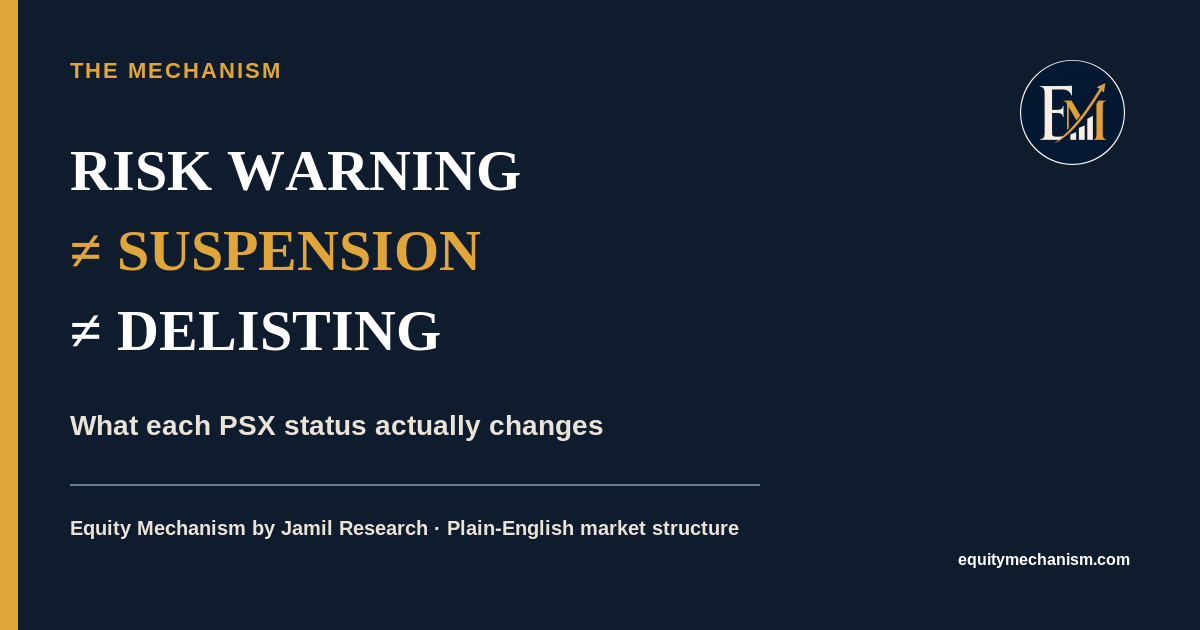
- Finding: A Risk Warning Alert, suspension and delisting are different PSX actions.
- Mechanism: The normal compliance process can move from a notice and time to fix a problem toward stronger action, but the exact route depends on the breach.
- Why it matters: A scary headline does not tell you whether trading is still open or whether the listing has ended.
- Falsifier: The reading must change if the exact PSX notice or the applicable regulation gives a different route for that company.
The question this article answers
When PSX uses words such as Risk Warning, suspension or delisting, what has actually changed?
The easiest mistake is to treat all three as different ways of saying the same thing. They are not.
On 11 September 2026, PSX posted a Risk Warning Alert against Pakistan Engineering Company Limited. The Exchange also posted separate suspension notices for Pakistan Hotels Developers Limited and Dewan Mushtaq Textile Mills Limited.
Those notices are useful because they show the basic point in real time: the label matters.
The evidence first
Verified fact: PSX Regulation 5.11 separates the Non-Compliant Segment, Winding-up Segment, Risk Warning Alert, suspension and delisting. They are not one status.
Verified fact: In the general process under Regulation 5.11.3, PSX can give a company a specified period, not exceeding 90 days, to correct a non-compliance. If the problem continues, a Risk Warning Alert and a further period not exceeding 90 days may follow where that route applies.
Verified fact: Regulation 5.11.5 describes a normal suspension mechanism using a 14-trading-day notice. If the company still has not fixed the problem after 7 trading days, trading moves to T+0 for the next 7 days. Continued failure leads to suspension from the 15th trading day.
Verified fact: The same regulation also contains an exception. A company falling under clause 5.11.1(f) can be suspended immediately without that normal suspension mechanism.
Named inference: The right first question for an investor is therefore not “Is this bad?” It is “What status did PSX apply, and what does that status change today?”
Risk Warning: the market is being warned
A Risk Warning Alert tells the market that a company is in a continuing problem covered by the relevant PSX rules and that stronger consequences can follow if the issue remains unresolved.
That does not automatically mean trading has already stopped.
This is why a Risk Warning should not be silently rewritten in your mind as “suspended”.
The PECO example makes the distinction easy to see. PSX's company page labels PECO as non-compliant and carries the Risk Warning description. That is a regulatory warning state, not the same word as suspension.
Suspension: trading has stopped
Suspension changes something more immediate: trading in the shares is stopped while the suspension applies.
Under the normal mechanism in Regulation 5.11.5, PSX gives a 14-trading-day notice before suspension. The rule also describes the interim T+0 period after the first 7 trading days if the problem is still not fixed.
But this is where the simple “ladder” idea can become misleading.
Some grounds have their own action. Regulation 5.11.5 expressly says the normal suspension mechanism does not apply to the immediate-suspension case under clause 5.11.1(f).
So a useful visual is not always:
warning → suspension → delisting.
The safer reading is:
specific breach → applicable PSX rule → current status → next stated action.
Delisting: the listing itself ends
Delisting goes further than a trading suspension.
A suspended company can still be a listed company even though its shares are not trading normally. Delisting means the security leaves the Exchange listing.
Regulation 5.11 also contains different delisting routes. For example, the general non-compliance process can move toward compulsory buy-back directions and delisting, while Regulation 5.11.6 separately deals with liquidation-related delisting.
This is another reason not to assume that every company follows one identical sequence.
A simple four-question check
Before reacting to a regulatory headline, check four things.
1. What is the exact status? Risk Warning, suspension and delisting are different.
2. Can the share still trade? Do not infer this from the tone of the headline.
3. Which rule or breach is named? The cause determines the route.
4. What does PSX say happens next? Read the deadline, remedy and next action in the notice.
The four questions turn an emotional headline into a process that can be checked.
Why the 11 September notices matter
The three 11 September notices should not be read as if the companies had the same problem.
That is not what the evidence proves.
What they do prove is narrower and more useful: PSX can use different regulatory actions, and the action named in the notice tells you what has changed.
Verified fact: PSX posted a Risk Warning Alert against PECO and separate suspension notices for Pakistan Hotels Developers and Dewan Mushtaq Textile Mills on 11 September 2026.
Named inference: Seeing those different notices on the same day is a useful reminder to read the status before forming a conclusion about the company.
Alternative explanation and limitations
The rulebook is detailed, and individual cases can have their own history, breach, court process, winding-up process or other facts.
This article is not claiming that all Risk Warnings have the same cause. It is also not claiming that every suspension is preceded by a Risk Warning.
- Open risk: A reader can still reach the wrong conclusion if they use this explainer without reading the company-specific PSX notice.
- Falsifier: If the exact notice or a later PSX amendment specifies a different action, timing or route, that specific source overrides the simplified explanation here.
What to watch
For any company carrying a PSX regulatory label, watch the next Exchange notice. The important question is whether the company fixes the stated breach, receives another period, moves to a stronger action, or returns to normal status.
Method and calculations
This note uses the PSX announcements displayed for 11 September 2026 and the PSX Regulations linked by the Exchange as the governing rulebook.
No market-price, return, valuation or trading-volume calculation is used.
The time periods quoted from Regulation 5.11 are regulatory process windows, not forecasts. “Not exceeding 90 days” is preserved as written rather than converted into a guaranteed 90-day period.
Primary sources
- Pakistan Stock Exchange, announcements and notices, 11 September 2026
- Pakistan Stock Exchange Regulations, updated 9 February 2026, Regulation 5.11
- Pakistan Engineering Company Limited, PSX company page
- Dewan Mushtaq Textile Mills Limited, PSX company page
- Pakistan Hotels Developers Limited, PSX company page