- Data as of
- 2026-08-31 post-close PKT
- Tickers
- ACPL, SLM, SYS
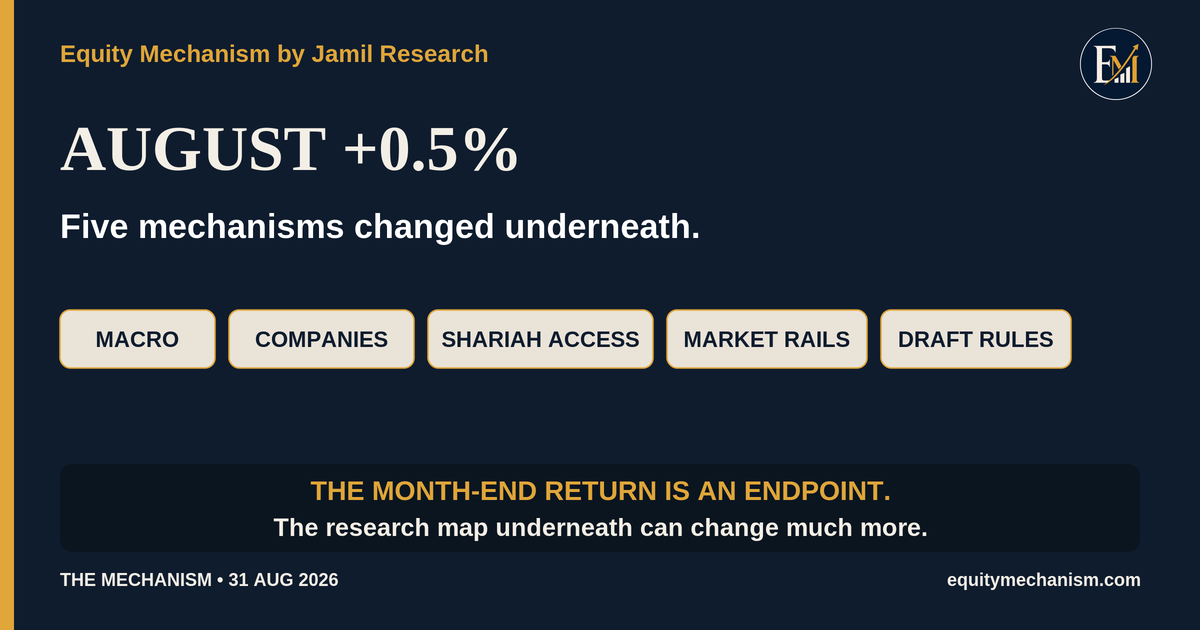
The KSE-100 ended August 2026 at 176,975.67, compared with 176,094.12 on 31 July.
That is a calculated month-on-month gain of about 0.5%.
A half-percent move can look like a quiet month. It was not a quiet month for the information investors had to process.
The useful way to read August is not to force every development into an explanation for the index return. It is to separate the benchmark endpoint from the mechanisms that changed underneath it.
The 20-second view
- Verified fact: The KSE-100 rose about 0.5% from the 31 July close to the 31 August close.
- Macro: SBP-held reserves were broadly steady, moving from US$17.043bn at 31 July to US$17.099bn at 21 August.
- Company evidence: August financial results changed the questions at ACPL, SLM and Systems in different ways.
- Market structure: SECP expanded Shariah-compliant brokerage access, established a Corporate Debt Market Desk and approved a REIT public offering.
- Regulatory pipeline: SECP published draft broker-regulation amendments on 19 August. Draft status is not the same as a final rule in force.
The key distinction is simple:
these are not five causes of the +0.5% return. They are five changes the month-end endpoint does not show.
1. The market endpoint moved only a little
The starting point for this review is deliberately narrow.
PSX's 31 August market summary shows the KSE-100 at 176,975.67. The governed 31 July PSX daily-market record shows 176,094.12.
The calculation is:
(176,975.67 ÷ 176,094.12 − 1) × 100 = 0.5006%
Rounded to one decimal place, August was +0.5%.
That number answers one question: where did the benchmark finish relative to the previous month-end?
It does not answer several other questions:
- Did the macro buffer improve or deteriorate?
- Did company earnings evidence become stronger or weaker?
- Did market access change?
- Did new financing or investment channels appear?
- Did the regulatory rulebook change?
Those require separate evidence.
2. The macro buffer was broadly steady, not transformed
At 31 July, SBP reported US$17.043bn of reserves held by the central bank.
By 21 August, that figure was US$17.099bn.
The change is small. That is the point.
The evidence does not support describing August as a reserve surge. It also does not show a large deterioration in this part of the external-liquidity backdrop.
The transmission mechanism is:
reserve position → external-liquidity buffer → currency and confidence conditions → financing/import capacity → sector and company risk
Each arrow needs its own evidence. A broadly steady reserve figure does not automatically mean the currency, imports, financing costs or equity valuations should move in one direction.
What this means for PSX research
A stable macro buffer changes the background condition, not every company outcome.
Exporters, import-dependent manufacturers, banks, energy companies and highly leveraged firms can still react differently because their operating exposures are different.
That is why company filings matter.
3. August company results did not tell one story
A month-end index compresses hundreds of company-level developments into one weighted number.
August results show why that compression can hide useful differences.
Attock Cement: stronger annual sales and profit
ACPL announced FY2026 financial results on 11 August.
PSX's company page shows annual sales of approximately PKR 44.325bn, up from PKR 33.309bn in FY2025.
Profit after tax rose to approximately PKR 3.416bn from PKR 1.731bn.
That is calculated growth of about 33.1% in sales and 97.3% in profit after tax.
The immediate research question shifts from "did earnings recover?" toward what drove the margin and profit improvement, and how repeatable are those drivers?
SLM: growth, but a margin question remains
SLM announced FY2026 results on 17 August.
PSX shows sales of approximately PKR 71.709bn, up from PKR 49.840bn, while profit after tax rose to approximately PKR 13.529bn from PKR 10.025bn.
That is calculated growth of about 43.9% in sales and 34.9% in profit after tax.
But PSX also displays net profit margin at 18.87% for FY2026 versus 20.11% for FY2025.
So the research question is not merely whether sales and profit grew. It is also what happened to the conversion of revenue into profit.
Systems: sales rose while Q2 profit was lower year on year
Systems announced its half-year financial results on 27 August.
For Q2 2026, PSX displays sales of approximately PKR 13.313bn, compared with PKR 10.820bn in Q2 2025.
That is calculated sales growth of about 23.0%.
Quarterly profit after tax, however, was approximately PKR 1.428bn versus PKR 2.003bn a year earlier, a calculated decline of about 28.7%.
That changes the question from "is revenue growing?" to how much of that growth is reaching profit, and what is happening below the revenue line?
The company-level lesson
These three examples are not a representative sample of the entire PSX.
They serve a narrower purpose.
They show that August company evidence moved in different directions even while the benchmark's month-end return was small.
The mechanism is:
new filing → new operating evidence → revised company question → sector/company interpretation
The index endpoint cannot replace that work.
4. Market access changed
On 12 August, SECP announced a dedicated Shariah-compliant brokerage segment.
The regulator said 33 brokerage houses were operating dedicated Shariah-compliant windows, while two other dedicated brokers were offering Islamic brokerage services.
This is a market-access development.
The careful interpretation is not that 52% of PSX trading became Islamic. SECP's wording linked the roughly 52% figure to the total PSX traded-volume footprint of the brokerage houses operating those windows.
That is a different statistic from trading executed specifically through the Islamic windows.
The mechanism to watch is:
dedicated access channel → easier product/service identification → potential investor onboarding → actual usage → persistent participation
Only the later steps can show whether access translated into meaningful new activity.
5. New capital-market rails appeared
August also added infrastructure outside the ordinary equity-trading story.
Corporate Debt Market Desk
SECP announced on 17 August that it had established a Corporate Debt Market Desk.
A dedicated desk can reduce information and process friction for issuers and market participants.
But infrastructure is not liquidity.
The mechanism is conditional:
facilitation → issuer pipeline → issuance → investor distribution → secondary trading
A desk can support the first steps. It cannot guarantee the later ones.
Naya Nazimabad Apartment REIT
On 18 August, SECP announced approval of the public offering of Naya Nazimabad Apartment REIT.
PSX PRIDE shows the listing application as approved by PSX and SECP, with book building scheduled for 1–2 September 2026 and public subscription for 7–8 September 2026.
This is important because it moves the story from an abstract market-development plan toward an actual financing/investment pathway with scheduled market-facing steps.
Again, the mechanism matters more than the announcement headline:
approved structure → book building → subscription → listing → secondary-market participation
The later steps remain to be observed.
6. The rulebook changed direction, but the August broker amendments remained draft
On 19 August, SECP posted S.R.O.1376(I)/2026, described as draft amendments to the Securities Brokers (Licensing & Operations) Regulations, 2016.
The word draft is important.
A draft can signal regulatory direction. It can invite market participants to prepare for a possible change. It can also change before final notification.
The correct status chain is:
draft → consultation → possible revision → final notification → effective requirement
So the August fact is that broker-regulation proposals entered the formal draft pipeline.
The evidence does not justify treating every proposed amendment as already binding.
What the +0.5% headline hides
The month-end return and the five mechanisms answer different questions.
The return says:
the KSE-100 ended August slightly above its 31 July level.
The mechanisms say:
- the external reserve buffer was broadly steady;
- new company filings changed operating and earnings questions;
- Shariah-compliant brokerage access expanded;
- debt/REIT market infrastructure moved forward; and
- broker-regulation proposals entered a new draft stage.
Those changes can matter for future market behaviour without being identified as the cause of the August return.
That distinction prevents two common errors:
- treating a small index move as evidence that little changed; and
- treating every August development as an explanation for the same index move.
Alternative interpretation
A reasonable alternative reading is that many of these developments were incremental rather than transformative.
That is plausible.
The reserve change was small. A market-access announcement does not prove new active investors. A debt-market desk does not prove liquid secondary trading. A REIT approval is not the same as successful book building and listing. Draft broker rules can still change.
This is why the article's conclusion is not that August transformed the PSX.
It is narrower:
August changed the research map more than the +0.5% endpoint suggests.
Risks, limits and falsifiers
Data limitation
This review deliberately excludes a full-month participant-flow conclusion because the governed August NCCPL data set is incomplete for some dates/scopes.
Company-sample limitation
ACPL, SLM and Systems are selected examples of August filings. They do not represent the entire listed market.
Infrastructure limitation
New rails and access channels are inputs. Their value must be tested through actual issuance, subscription, trading, onboarding and persistence.
Regulatory limitation
The 19 August broker amendments were published as draft amendments. Any final conclusion must be updated if SECP issues a superseding final notification.
Falsifier
The month-return calculation must be updated if PSX corrects either the 31 July or 31 August closing level.
What to watch in September
The useful September checklist is not one forecast. It is a set of confirmation tests:
- whether SBP reserves remain broadly stable or move materially;
- whether inflation and rate expectations change the financing backdrop;
- whether August company results are followed by similar or divergent operating evidence;
- whether the Shariah-compliant brokerage segment shows sustained practical usage;
- how the Naya Nazimabad Apartment REIT book building and public subscription progress;
- whether the Corporate Debt Market Desk is followed by visible issuance or market activity;
- whether SECP finalises, revises or leaves the August draft broker amendments pending; and
- whether broader market participation confirms or contradicts the small month-end index move.
Method and calculations
- August KSE-100 return is calculated from verified PSX closes: 176,094.12 on 31 July 2026 and 176,975.67 on 31 August 2026.
- Percentage displayed publicly is rounded to one decimal place.
- Company growth percentages are Equity Mechanism calculations from PSX-displayed financial figures.
- SBP reserve figures are official liquid foreign-exchange reserve observations for the dates stated.
- No full-month NCCPL participant-flow total is used.
- No REG, NDM, FUT or GEM volumes are combined into a claim about ordinary ready-market activity.
Primary sources
- Pakistan Stock Exchange, Market Summary, 31 August 2026: https://www.psx.com.pk/market-summary/
- Pakistan Stock Exchange, Daily Stock Market Report, 31 July 2026, archived PSX primary report preserved in the governed July evidence record.
- State Bank of Pakistan, Economic Data: Liquid Foreign Exchange Reserves: https://www.sbp.org.pk/ecodata/index.asp
- Securities and Exchange Commission of Pakistan, 2026 Press Releases, including 12, 17 and 18 August capital-market releases: https://www.secp.gov.pk/media-center/press-releases/?s-year=2026
- Securities and Exchange Commission of Pakistan, Draft Rules, Regulations and Concepts, S.R.O.1376(I)/2026 dated 19 August 2026: https://www.secp.gov.pk/laws/drafts-for-discussion/draft-rules-regulations/
- Pakistan Stock Exchange PRIDE, Naya Nazimabad Apartment REIT: https://www.psx.com.pk/psx/pride/main-board/naya-nazimabad-apartment-reit
- Pakistan Stock Exchange, Attock Cement Pakistan Limited company page and FY2026 results: https://dps.psx.com.pk/company/ACPL
- Pakistan Stock Exchange, Service Long March Tyres Limited company page and FY2026 results: https://dps.psx.com.pk/company/SLM
- Pakistan Stock Exchange, Systems Limited company page and Q2/H1 2026 results: https://dps.psx.com.pk/company/SYS
Related research
- July route analysis: https://equitymechanism.com/research/market-structure/july-return-hid-the-route
- Equity Mechanism research archive: https://equitymechanism.com/research/
Education & analysis, not investment advice.