- Data as of
- 2026-08-08 13:44 PKT
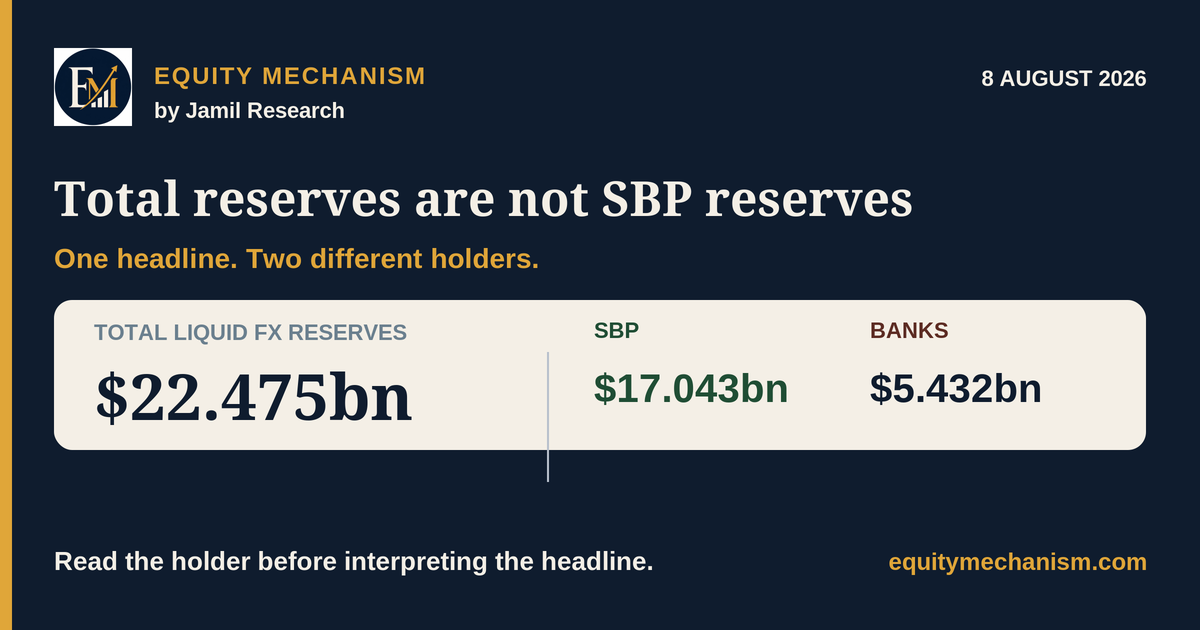
Pakistan’s latest liquid foreign-exchange reserve headline is $22.475bn.
That figure is correct. But it does not mean the State Bank of Pakistan itself held $22.475bn.
The official total combines $17.043bn held by SBP and $5.432bn held by commercial banks, both measured as of 31 July 2026.
That distinction is the point of this article: before using “Pakistan’s reserves” as a market signal, identify which reserve measure you are actually reading.
The common shortcut
A reserve headline is easy to compress into a sentence such as:
“Pakistan has $22.475bn of reserves.”
As shorthand, that can be acceptable if the scope remains clear.
The problem begins when the same number is silently turned into:
“SBP has $22.475bn.”
That is a different statement. The reported total contains two holders, so the national headline total and the central-bank component are not interchangeable.
The numerical example
| Reserve measure | USD bn | What it describes |
|---|---|---|
| SBP reserves | 17.043 | Central-bank component |
| Commercial-bank reserves | 5.432 | Banking-system component |
| Total liquid FX reserves | 22.475 | Combined official headline |
The arithmetic is exact at the published precision:
$17.043bn + $5.432bn = $22.475bn
No percentage split is needed to understand the mechanism.
- Verified figure: total liquid foreign-exchange reserves were $22.475bn.
- Composition: $17.043bn was held by SBP and $5.432bn by commercial banks.
- Mechanism: reserve ownership changes what the headline can and cannot tell us about external liquidity.
- Interpretation limit: the SBP figure should not automatically be described as fully unrestricted or “freely usable” cash without the accompanying reserve-detail and liability context.
Total reserve headline → identify the holder → read the composition → assess external-liquidity context → then consider currency, financing, sector and company exposure
Why the holder changes the interpretation
The two components sit with different holders. That alone means they should not be treated as one central-bank cash balance.
For an investor or analyst, the first discipline is therefore a scope check:
- Is the number the combined liquid-reserve total?
- Is it the SBP component?
- Is it the commercial-bank component?
- Is the comparison using the same measure across time?
A trend built from inconsistent scopes can be numerically correct at each point and still produce a misleading conclusion.
Verified fact: SBP reports the reserve headline as separate SBP and bank components that add to the total.
Named inference: Separating those components gives a cleaner starting point for judging external-liquidity conditions than treating the headline total as if it were entirely held by the central bank.
What the data does not establish: The holder split alone does not establish how much of the SBP figure is immediately or unrestrictedly available for every policy purpose.
Why “SBP reserves” still needs another layer
Correcting the first shortcut does not justify a second one.
Once we isolate the $17.043bn SBP component, it may be tempting to call the whole amount “free cash” or an immediately deployable buffer. This article does not make that claim.
A stronger assessment of usable external buffers needs the relevant reserve-asset, liability, encumbrance and external-obligation detail. The weekly headline is a useful top-line indicator, but it is not a complete balance-sheet analysis.
That is why the safer chain is:
reported reserves → holder → composition → detailed reserve context → external-liquidity interpretation
not:
headline total → instant conclusion
How this reaches PSX analysis
Reserve data matters to equity research through a transmission mechanism, not through a mechanical buy-or-sell rule.
A sustained change in external-liquidity conditions can influence how investors think about currency risk, import financing, external funding conditions and macro stability.
Those channels can matter differently across sectors. Companies with imported inputs, foreign-currency obligations or sensitivity to financing conditions may face a different transmission path from businesses whose costs and revenues are mainly domestic.
That is a named inference, not a claim that one weekly reserve figure determines the direction of the KSE-100 or any individual stock.
What the headline can hide
Three interpretation errors are especially easy to make.
1. Treating the combined total as the SBP balance
This changes the measurement scope.
2. Ignoring the commercial-bank component entirely
The bank component is part of the official total. Removing it answers a different question: the size of central-bank reserves rather than the size of total liquid reserves.
3. Treating the SBP component as automatically unrestricted
The weekly top line does not, by itself, prove the amount available for every possible external payment or policy use.
A careful reading keeps all three distinctions intact.
Alternative interpretation
A reader may argue that the combined headline is the most important number because it gives the broadest view of liquid foreign-exchange reserves in the system.
That is a reasonable use of the total.
The issue is not that the total is wrong or unimportant. The issue is what question it answers.
Use the total when the question is about the combined reserve position. Use the SBP component when the question is specifically about reserves held by the central bank. Do not substitute one for the other.
Data limitation: This article uses the approved SBP reserve position as of 31 July 2026 and does not attempt to reconstruct every underlying reserve asset or liability.
Scope risk: “Total liquid reserves,” “SBP reserves,” and “bank reserves” must remain separately labelled.
Interpretation risk: A single weekly observation can be over-read as a complete external-sector signal.
Falsifier: Any subsequent SBP correction to the 31 July reserve figures would require the figures and derived discussion to be updated.
- The next SBP liquid-reserve update.
- Whether the SBP and commercial-bank components move in the same or opposite directions.
- Official external-debt payments and other large foreign-currency inflows or outflows.
- The broader reserve-asset and liability detail when assessing the effective buffer.
- Whether external-sector indicators confirm or contradict the message implied by the reserve trend.
How readers can verify the number
The verification sequence is simple:
- Open the State Bank of Pakistan’s official economic-data reserve position.
- Confirm the reference date.
- Read the SBP reserves line.
- Read the banks’ reserves line.
- Add the two figures and confirm they match total reserves.
- Keep the same scope when comparing with another date.
For 31 July 2026:
17.043 + 5.432 = 22.475
That is the complete calculation used in this article.
Method and calculation note
All figures are shown in US dollars, billions, rounded to three decimal places to match the approved production record.
No reserve-share percentage is used in the public analysis.
The article does not estimate import cover, unrestricted usability, net international reserves or any other reserve metric that is not directly established by the approved source set.
Sources & notes
- State Bank of Pakistan: official website. Liquid Foreign Exchange Reserves / Economic Data, position as of 31 July 2026.