- Ticker
- UBL
One-sentence thesis
UBL's first-half profit increased materially, but the result becomes more informative when recurring net mark-up income, securities gains, operating costs and future capital commitments are assessed separately.
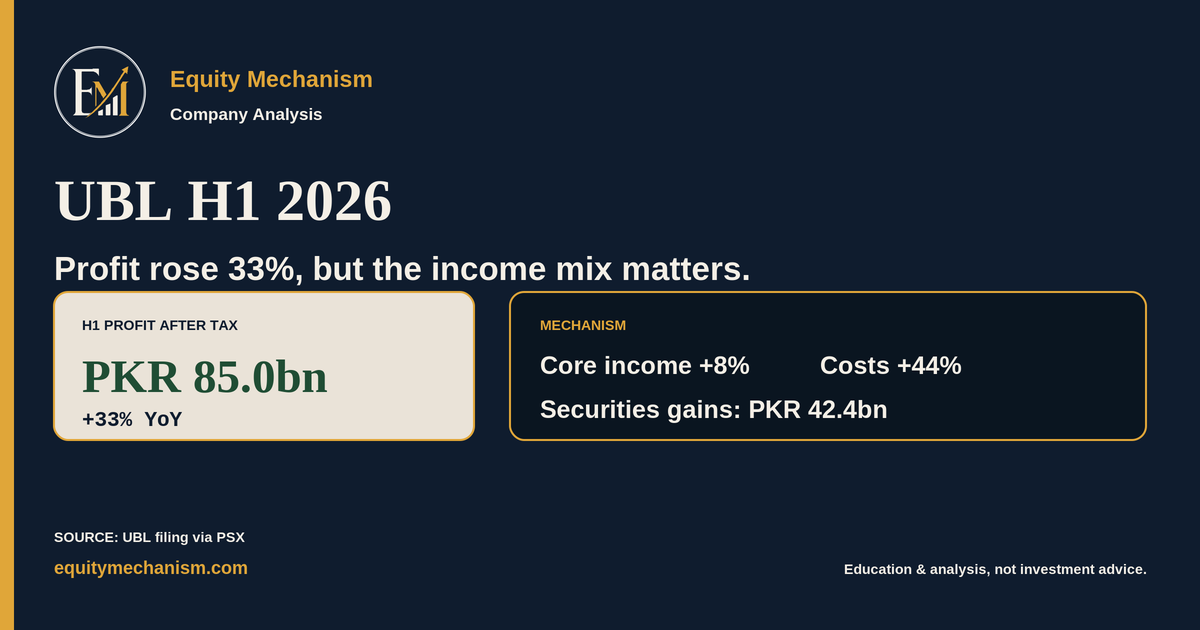
- Standalone profit after tax rose 33.2% to PKR 84.97bn, while EPS increased to PKR 33.93.
- H1 net mark-up income grew 8.1%, but the second-quarter figure was 1.0% lower year on year.
- Securities gains reached PKR 42.39bn in H1, compared with PKR 8.15bn a year earlier.
- Operating expenses increased 43.8%, faster than total-income growth of 26.5%.
- New capital commitments widen the watchlist beyond the income statement.
The mechanism is simple: UBL’s H1 core income improved, securities gains added a material boost, and faster operating-cost growth absorbed part of that uplift. The result was higher first-half profit, but with open questions about repeatability.
What happened
United Bank Limited reported standalone profit after tax of PKR 84.97bn for the six months ended 30 June 2026, compared with PKR 63.79bn in the same period last year. That is an increase of 33.2%. Earnings per share rose to PKR 33.93 from PKR 25.69.
The board also announced a second-quarter interim cash dividend of PKR 8 per share, in addition to the PKR 8 per share already paid for the first quarter.
Those figures establish the headline. They do not, by themselves, explain the quality or repeatability of the growth.
The mechanism
1. Core income grew over the half year
Net mark-up income is the difference between the mark-up a bank earns and the mark-up it pays. It is a central measure of recurring banking income.
UBL's standalone net mark-up income increased to PKR 189.70bn in H1 2026 from PKR 175.42bn a year earlier, an increase of 8.1%.
That is positive support for the result, but the quarterly view is less straightforward. Second-quarter net mark-up income was PKR 90.28bn, around 1.0% below the PKR 91.20bn reported in the second quarter of 2025.
The half-year number improved while the latest quarterly run rate weakened. Both statements are correct because they cover different comparison windows.
2. Non-mark-up income did more of the work
H1 non-mark-up income increased to PKR 71.06bn from PKR 30.78bn, a rise of 130.8%.
The largest change came from net gains on securities. These reached PKR 42.39bn, compared with PKR 8.15bn in the prior-year period. The current figure is about 5.2 times the earlier amount.
The quarterly pattern was also strong. Second-quarter securities gains were PKR 11.86bn versus PKR 2.32bn a year earlier.
Verified fact: securities gains made a materially larger contribution to UBL's income in both H1 and Q2.
Named inference: the result should not be assessed as though every rupee of the income increase has the same level of repeatability. Securities gains can vary with portfolio decisions and market conditions.
3. Costs absorbed part of the uplift
Operating expenses increased to PKR 84.07bn in H1 from PKR 58.49bn, a rise of 43.8%.
Total income grew 26.5% over the same period. Expenses therefore increased faster than total income.
The profit result still improved because the combined income uplift was large. However, cost growth remains a central part of the mechanism rather than a footnote.
4. Capital allocation expands the analysis
The result announcement included three proposed commitments beyond the dividend.
First, UBL proposed a PKR 8bn investment in a majority-owned agriculture-focused subsidiary. The stated objective is to provide technology-enabled advisory and research services for agriculture productivity, sustainability and farmer incomes.
Second, the board approved a further equity investment of up to PKR 22bn in Khushhali Microfinance Bank Limited through a rights issue, additional share acquisition and underwriting commitments. The filing stated that KMBL had negative equity of PKR 16.15bn at 31 December 2025.
Third, UBL proposed a PKR 10bn contribution over three to five years toward a not-for-profit university or charitable trust, with a matching contribution from the Bestway Foundation.
These proposals remain subject to the applicable shareholder, corporate and regulatory approvals. They should not be treated as one immediate PKR 40bn cash outflow.
What supports the result
- H1 standalone profit and EPS increased materially.
- Net mark-up income still grew over the six-month period.
- Securities gains provided substantial additional income.
- The bank maintained an interim dividend of PKR 8 per share for the second quarter.
What weakens the interpretation
- Q2 net mark-up income was slightly lower year on year.
- Operating expenses grew faster than total income in H1.
- A materially larger share of the income uplift came from securities gains, whose future level is uncertain.
- The proposed capital commitments add execution, approval and return-on-capital questions.
The main risk is not that the reported profit is incorrect. The risk is that readers may treat all components of the growth as equally recurring. A weaker core-income trend, persistent cost growth or poor returns on new capital deployment would reduce the quality of future earnings.
What the next reporting period should show
- Whether quarterly net mark-up income returns to year-on-year growth.
- The level of securities gains in the next reporting period.
- Operating-expense growth relative to total-income growth.
- Approval, timing and terms of the proposed KMBL investment.
- The business model and financial targets of the proposed agriculture subsidiary.
- How UBL reports the timing and accounting treatment of the university contribution.
What would change the view
A future result showing stronger recurring net mark-up income, slower cost growth and less dependence on securities gains would improve the earnings-quality picture.
The opposite combination would weaken it, even if the headline profit remained high.
Sources & notes
- Financial Results for the 2nd Quarter Ended 30 June 2026Filed with Pakistan Stock Exchange on 22 July 2026.
- UBL 2QCY26 Result ReviewUsed only as named secondary context for the quarterly funding-cost interpretation.