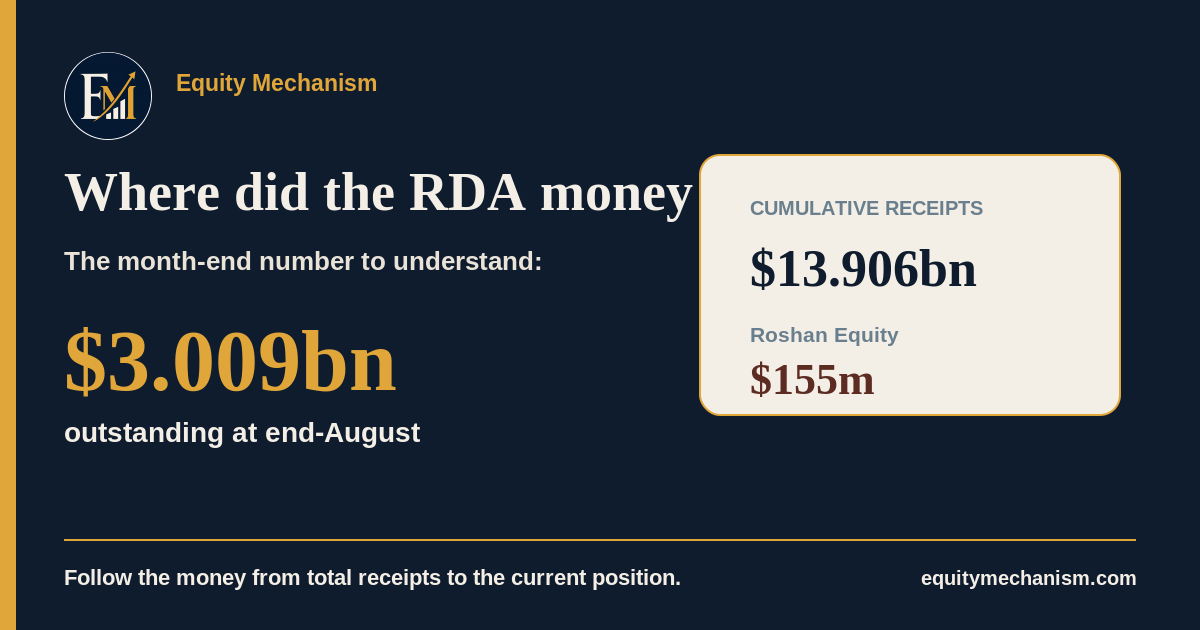
- Finding: SBP reports $13.906bn in cumulative RDA receipts through August 2026 and a $3.009bn month-end outstanding position.
- Mechanism: Cumulative receipts are reduced by funds that have been repatriated or utilised locally; the remaining amount is then split across NPCs, account balances, Roshan Equity and other liabilities.
- Why it matters: The headline inflow figure and the current outstanding position answer different questions.
- Falsifier: A later SBP revision or a new monthly release that materially changes the reported flow or composition would change this reading.
Start with the question, not the headline
Roshan Digital Accounts had received $13.906bn by the end of August 2026, according to the State Bank of Pakistan.
That number is useful. It tells us how much money has entered through RDA since launch.
But it does not tell us how much remained outstanding at the end of August.
For that question, SBP reports a different number: $3.009bn.
The distinction is simple once we separate a cumulative flow from a month-end position.
Follow the money
SBP's August 2026 table reports the following amounts in USD million:
| Measure | SBP-reported amount |
|---|---|
| Funds received since launch | $13,906m |
| Repatriated | $2,130m |
| Utilised locally | $8,767m |
| Total repatriated and utilised | $10,896m |
| Net repatriable liability | $3,009m |
SBP describes locally utilised funds as amounts that have already been consumed and are no longer an obligation. Its examples include transfers to non-repatriable accounts, cash withdrawals, bill payments, merchant transactions, fees and mobile top-ups.
Verified fact: SBP reports $13.906bn received and $3.009bn as the net repatriable liability at end-August 2026.
Named inference: If the reader's question is “how much RDA money remains outstanding at month-end?”, the $3.009bn position is more directly relevant than the cumulative $13.906bn receipt figure.
Where the $3.009bn position sits
SBP also publishes the composition of the outstanding RDA position.
| Outstanding component | August 2026 |
|---|---|
| Islamic Naya Pakistan Certificates | $1,332m |
| Account balances | $729m |
| Conventional Naya Pakistan Certificates | $716m |
| Roshan Equity Investments | $155m |
| Other liabilities | $78m |
This composition changes the market interpretation.
Roshan Equity Investments are directly connected to listed securities at PSX through the RDA framework. But the $155m equity figure is one component of the wider outstanding RDA position. Most of the reported amount sits in NPCs and account balances.
That means cumulative RDA receipts should not be described as if the full amount were current equity exposure to PSX.
A second distinction: activity versus position
A cumulative total grows as new receipts arrive, even if earlier money has already been repatriated or used.
A month-end position is different. It asks what remains outstanding at a particular date.
This is why the same RDA system can simultaneously show a large cumulative receipt figure and a much smaller outstanding balance without any contradiction.
The two numbers are measuring different things.
What changed in August
Using SBP's displayed July and August figures, the following changes are calculated:
- cumulative receipts increased by $259m;
- the outstanding RDA position increased by $83m;
- Roshan Equity Investments increased by $4m;
- the number of accounts increased by 9,354.
These are calculated differences from SBP's displayed month-end values, not separate SBP-reported change fields.
The movement again shows why cumulative activity and the outstanding stock can grow at different speeds.
Alternative explanation and limitations
There are several reasons to treat the visible totals carefully.
First, SBP marks the RDA statistics provisional.
Second, the table aggregates multiple currencies and converts them to US dollars using prevalent month-end exchange rates. A USD figure can therefore be affected by exchange-rate translation as well as underlying flows.
Third, SBP states that the net repatriable liability does not include profits, gains or losses.
Fourth, the displayed values are rounded to USD millions. Because of that rounding, visible components do not always add exactly to the displayed total. The correct approach is to preserve SBP's reported totals rather than forcing the rounded rows to reconcile arithmetically.
- Open risk: Later revisions, exchange-rate translation and changes in the mix of RDA assets can alter the reported USD position.
- Falsifier: A revised SBP series or a new monthly release showing a materially different flow or composition would weaken the current reading.
What to watch next
When SBP publishes the next RDA update, check four things separately: new receipts, repatriation and local utilisation, the month-end outstanding position, and the composition of that position. For PSX readers, track Roshan Equity as its own line rather than using total RDA receipts as a substitute.
Method and calculations
The analysis uses SBP's August 2026 RDA key-statistics table.
Reported amounts are preserved as SBP publishes them. The August-versus-July changes are calculated from displayed values and are labelled calculated.
No attempt is made to force rounded component values to equal rounded totals.
The article separates:
cumulative flow → money already repatriated or utilised → month-end outstanding position → composition of the outstanding position