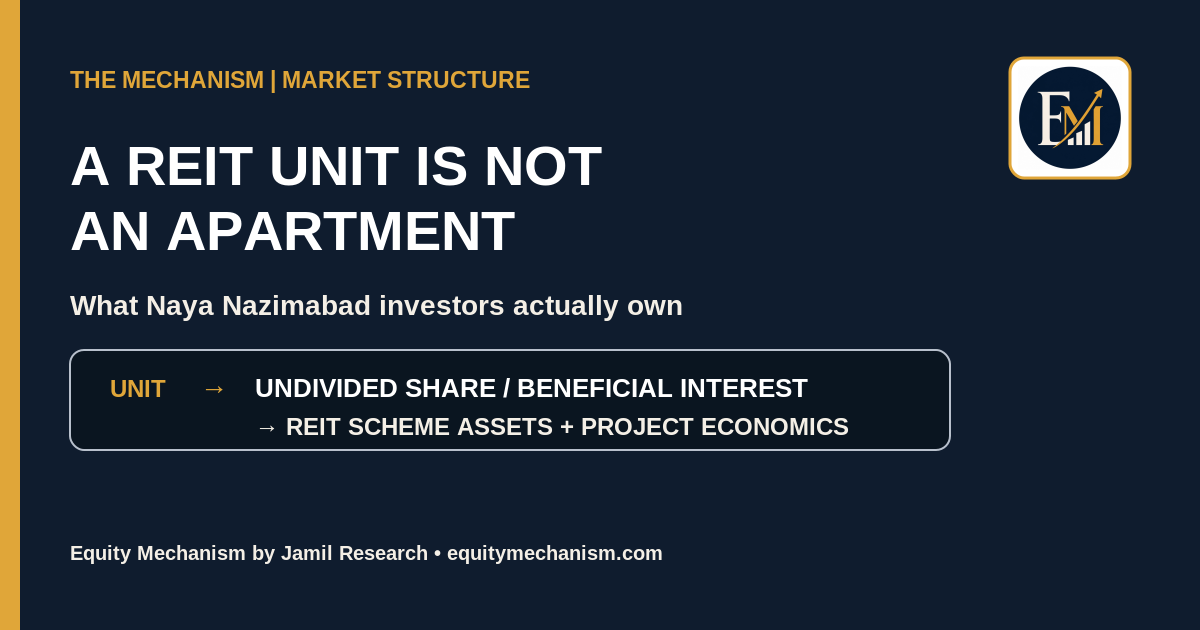
- Finding: A Naya Nazimabad Apartment REIT unit represents an undivided share in the REIT Scheme's assets and a proportionate beneficial interest in the REIT fund. It is not direct title to one specific apartment.
- Mechanism: Unit ownership links the investor to scheme-level assets, project cash flows, NAV, distributions and eventual secondary-market pricing.
- Why it matters: The ownership path identifies where the economic risks sit. For a developmental REIT, construction, costs, sales realisation and delays remain scheme-level risks.
- Falsifier: A later formal document that materially changes unit-holder rights, asset structure or the development plan would require this explanation to be updated.
The question this article answers
Naya Nazimabad Apartment REIT is scheduled to open public subscription on 7–8 September 2026. Book building closed on 2 September. A PSX-transmitted result dated 3 September reported a PKR 23 strike price and PKR 4,551 million of participation against a PKR 595 million book-building issue size, described in the filing as approximately 8x oversubscription.
That demand figure is current context, but it is not the most useful starting point.
The first question is simpler: what does a buyer of one REIT unit actually own?
The answer is not one apartment.
The evidence first
The final Offer for Sale Document describes Naya Nazimabad Apartment REIT as a closed-end developmental REIT Scheme. It says this is an Offer for Sale by Javedan Corporation Limited of 44,062,500 units, equal to 15% of the total units of the REIT Scheme.
Seventy-five percent of the offer was allocated to book building and 25% to the retail/general-public portion. Public subscription is scheduled for 7–8 September.
For the ownership question, the key definition is more important than the offer percentages. The document states that the units are registered and issued in the unit holder's name and represent an undivided share in the REIT Scheme's assets.
It further states that all units rank equally in their rights to net assets, earnings, dividends and distributions, and that each unit holder has a beneficial interest in the REIT fund proportionate to the units held.
Verified fact: NNAR units represent an undivided share in REIT assets. The Offer for Sale Document says each unit holder has a proportionate beneficial interest in the REIT fund.
Named inference: The clearest retail mental model is that the unit is the legal and economic bridge between the investor and the REIT Scheme. The investor is not receiving direct title to one numbered apartment.
The ownership chain
A direct property purchase and a REIT-unit purchase can both create exposure to real estate, but the legal paths are different.
With a direct property transaction, the buyer may acquire title to a specific identified property, subject to the transaction documents and applicable law.
With NNAR, the buyer acquires units in the REIT Scheme. The Offer for Sale Document says those units represent an undivided share in the REIT assets.
The trust structure adds another layer. The Offer for Sale Document identifies Central Depository Company of Pakistan Limited as trustee. The trust-deed provisions reproduced in that document state that the trustee holds title to the REIT assets in its own name as trustee for the exclusive benefit of all unit holders.
That produces a chain like this:
Investor → REIT unit → proportionate interest in REIT assets → project economics → NAV, distributions and market price
There is no one-to-one mapping between a unit and a particular apartment.
Why NAV, distributions and market price are different
The ownership distinction also helps separate three concepts that can easily be mixed together.
NAV is a measure of net assets attributable to the scheme.
Distributions depend on what the scheme can lawfully and practically distribute after costs, obligations and realised economics. The NNAR risk disclosures state that dividends, if any, depend on net profit after construction costs, project-management expenses and successful realisation of sales.
Market price, after listing, is the price at which buyers and sellers transact. It can differ from NAV because liquidity, expectations, risk perception and market demand can change.
A listed REIT unit is therefore not simply an apartment price divided into smaller pieces.
Why the developmental structure matters
NNAR is a developmental REIT with residential and commercial development components. Its own risk disclosures identify several transmission points:
- construction risk;
- sale of developed units and collection of sale proceeds;
- changes in commodity prices and estimated project costs;
- construction, labour or regulatory delays;
- the possibility that delays raise project costs and reduce returns to unit holders.
These are scheme-level risks.
- Open risk: Public subscription is imminent, but the PSX PRIDE page still shows the listing date as pending. Post-listing liquidity is therefore not yet observable.
- Open risk: Construction, project costs, sales realisation and delays can affect scheme economics.
- Falsifier: A later formal disclosure that materially changes the scheme structure, unit-holder rights or project plan would require the mechanism map to be revised.
What the book-building result does and does not tell us
The 3 September filing reported PKR 4,551 million of participation against a PKR 595 million book-building issue size. It also reported 292 participants and 249 successful investors.
That is a verified observation about book-building demand.
It is not evidence by itself that the unit is fairly valued, that its market price will rise after listing, or that future distributions will reach any particular level.
Demand during book building and the economic value of the underlying scheme are different questions.
What to watch
The next formal milestones are the public-subscription outcome, the confirmed listing date, initial post-listing liquidity, subsequent NAV disclosures and project-execution updates. Those data will show how the legal claim represented by the unit translates into actual scheme performance and market behaviour.
Alternative explanation and limitations
A reader may reasonably view the REIT unit mainly as a convenient way to obtain listed real-estate exposure. That is directionally useful, but it can become misleading if it hides the developmental nature of this scheme or implies ownership of a specific apartment.
The Offer for Sale Document is extensive and contains project, financing, valuation, regulatory and trust-deed detail beyond the narrow ownership question addressed here. This article does not substitute for the complete offer document.
Method and calculations
This article uses primary-source material from PSX and SECP only.
The approximately 8x figure is reported by the 3 September filing. No valuation multiple, return forecast, target price or subscription recommendation is calculated from it.
The analysis separates:
verified fact → named inference → open risk → watch item → falsifier
Primary sources
- Pakistan Stock Exchange, Naya Nazimabad Apartment REIT PRIDE page, current status checked 5 September 2026: https://www.psx.com.pk/psx/pride/main-board/naya-nazimabad-apartment-reit
- Pakistan Stock Exchange, Naya Nazimabad Apartment REIT Offer for Sale Document, published 20 August 2026: https://www.psx.com.pk/psx/themes/psx/uploads/NNAR-OFSD.pdf
- Pakistan Stock Exchange transmission, Book Building Results of the Offer for Sale of Naya Nazimabad Apartment REIT, dated 3 September 2026: https://dps.psx.com.pk/download/document/282188.pdf
- Securities and Exchange Commission of Pakistan, Real Estate Investment Trust Regulations, 2022, updated till 1 January 2026, published 15 January 2026: https://www.secp.gov.pk/document/real-estate-investment-trust-regulations-2022-updated-till-january-1-2026/