- Data as of
- 2026-08-09 11:54 PKT
The 20-second view
- Verified fact: SECP registered 5,438 new companies during July 2026, its highest monthly incorporation count on record.
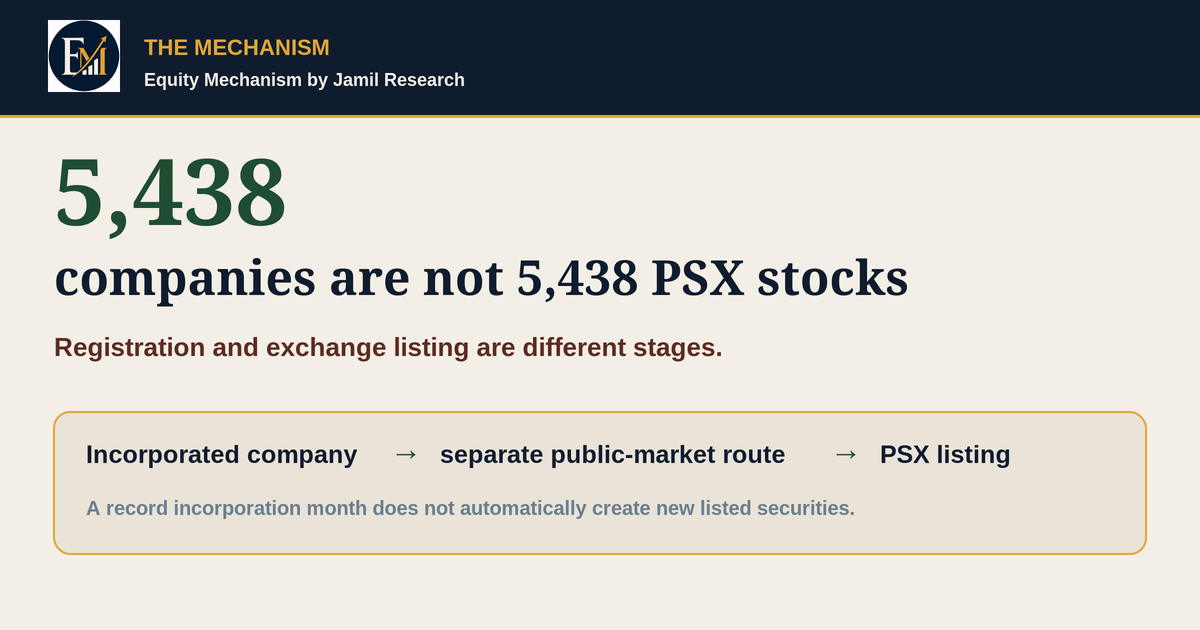
- Correct interpretation: That is a measure of company formation, not a count of new stocks admitted to trading on the Pakistan Stock Exchange.
- Mechanism: Incorporation creates the legal entity. PSX listing is a separate regulated process involving preparation, application, market-facing steps and formal listing.
- What to watch: If the question is whether the public equity market is expanding, follow actual listing applications, public offers and completed listings rather than incorporation totals alone.
The misconception
“SECP registered 5,438 companies in July” is a striking headline.
But a reader can easily make the wrong jump:
5,438 new companies → 5,438 new stocks.
That is not what the data says.
The SECP number records incorporations. A PSX-listed share appears only after a company follows a separate capital-market route and reaches formal listing.
Those are related parts of the corporate system, but they are not the same event.
What SECP actually counted
SECP’s 6 August 2026 press release states that 5,438 new companies were registered during July 2026, the highest monthly number in the Commission’s history.
The composition is useful because it shows what sits inside the headline total:
| July 2026 registration category | Count / share reported by SECP |
|---|---|
| Private companies | 3,148 / 57.9% |
| Single-member companies | 2,117 / 38.9% |
| Limited Liability Partnerships | 127 |
| Section 42 non-profit companies | 28 |
| Public companies and other entities | 18 |
Private companies and single-member companies together represented 96.8% of the month’s registrations.
That composition is an important guardrail. The 5,438 total covers company formation across different legal forms and categories. It is not a ready-made pool of 5,438 exchange-traded securities.
Incorporation answers one question
Incorporation answers:
Has a legal corporate entity been registered?
That matters. Formal incorporation can support governance, contracting, financing and business continuity. SECP links the rise in formal corporate structures with legal protection, improved governance and easier access to finance.
But none of that automatically answers a different question:
Has this company become a PSX-listed issuer whose shares can trade on the exchange?
For that, we need the listing process.
Listing answers another question
PSX presents Main Board listing as a separate procedure.
Its public listing page describes four broad stages:
- Choose and appoint a Consultant-to-the-Issue.
- Prepare the application.
- Market to investors.
- Complete the Initial Public Offering and formal listing.
The official PSX Listing Guide adds more detail around documentation, regulatory review, the prospectus, public comments, approvals, the public offer and the eventual notice of listing.
So the public-market path is better understood as:
company incorporated → business develops → company chooses a public-market route → listing preparation and application → regulatory/exchange process → public offering → formal listing
An incorporation sits near the beginning of that chain. A listed stock sits near the end.
A simple numerical example
Imagine 100 companies are incorporated in one month.
The incorporation statistic is 100.
If only a subset later decides to pursue a stock-exchange listing, only that subset enters the listing pipeline. If fewer still complete the required process and are formally admitted to PSX, the number of new listed stocks is smaller again.
The exact conversion rate is not given by the July SECP release, so this article does not estimate one.
That is the point: the incorporation headline alone does not provide the missing conversion data.
Why the 5,438 record still matters
Correcting the interpretation does not make the number unimportant. A record month of company formation tells us that the formal corporate base expanded quickly in July.
That can matter over time because a larger corporate base creates more entities that may grow, seek external finance, professionalise governance or eventually consider public capital.
But that last step is an inference, not a verified outcome.
Named inference: a larger formal corporate base may increase the long-run pool from which future issuers could emerge.
What is not verified: that July’s record incorporations will produce a proportional rise in IPOs or PSX listings.
The evidence for that would have to come later.
The common interpretation error
The error is mixing two different data sets:
Company-formation data
- registrations
- legal forms
- sectors
- locations
- shareholder/director characteristics
Public-market data
- listing applications
- prospectuses
- public offers
- IPO completions
- notices of listing
- listed securities
Both can describe development in Pakistan’s corporate ecosystem.
They simply describe different stages.
How to verify the distinction yourself
When you see a headline about “new companies,” ask three questions.
1. What was counted? Was it incorporations, public companies, IPO applications, approved offerings or completed listings?
2. Which institution published it? SECP corporate-registration statistics and PSX listing statistics answer different questions.
3. What stage of the mechanism does the number represent? Registration is upstream. Formal exchange listing is downstream.
That three-question check prevents a large headline number from being carried into the wrong market conclusion.
Alternative interpretation
Could record company formation still be positive for Pakistan’s capital-market development?
Potentially, yes. A deeper corporate base can be helpful because public markets need companies that are large enough, organised enough and willing to raise public capital.
But incorporation growth can also remain entirely outside the stock market. Companies may stay private or never seek an exchange listing.
That is why the connection should be treated as a possible pipeline, not an automatic transmission.
Risks, limits and falsifiers
Data limitation: The SECP release provides incorporation statistics; it does not provide a future-listing conversion rate.
Scope limitation: The 5,438 total includes multiple entity categories. It should not be described as 5,438 public companies.
Interpretation risk: A record in formal company formation can be mistakenly presented as immediate stock-market deepening.
Falsifier: If later PSX data shows no corresponding rise in listing applications, public offers or completed listings, the idea that incorporation growth is feeding the public-market pipeline would be weakened.
The listing sequence to follow
For the public-market question, the useful sequence is:
listing applications → prospectus/approval activity → public offers → completed PSX listings
Those are the downstream measures that can show whether a larger corporate base is actually translating into more public-market issuers.
Until then, the clean conclusion is:
5,438 new companies was a record for incorporation. It was not 5,438 new PSX stocks.
Method and calculations
The article uses SECP’s July 2026 company-registration release and official PSX listing material.
The 96.8% figure is a simple addition of the SECP-reported shares for private companies (57.9%) and single-member companies (38.9%).
No estimate is made for the percentage of incorporated companies that will eventually list.
Sources & notes
- SECP Registers Record 5,438 Companies in July, Highest-Ever Monthly Incorporations
- Want To List — Main BoardOfficial listing procedure, accessed 9 August 2026.
- Listing GuideOfficial PSX guide.