- Data as of
- 2026-08-30 20:30 PKT
- Ticker
- PKGP
The 20-second view
- Finding: Pakgen is now an investment-focused company, not a continuing power-generation business.
- Mechanism: The power agreement ended, generation stopped, almost half the shares were cancelled, and capital shifted into investments and assets awaiting sale.
- Why it matters: Plant output is no longer the main lens. Portfolio returns, asset-sale outcomes and future capital allocation now matter more.
- What could change the reading: A binding FESCO transaction, a major asset sale, a new investment or a different distribution policy could materially change the balance-sheet map.
The question this article answers
Pakgen still appears under the PKGP symbol and many investors know it as an independent power producer. But the filing for the half year ended 30 June 2026 describes a different company. Its power purchase agreement ended on 31 January 2025, electricity generation stopped, shareholders approved an alternate business plan, and the name changed from Pakgen Power Limited to Pakgen Limited.
That raises a practical shareholder question: what does one Pakgen share represent now?
The short answer is a claim on an investment-focused balance sheet, a strategic holding in Rafhan Maize, land and buildings held for appreciation, legacy power assets being sold, and the future decisions of the capital allocator. The old operating asset has become a disposal and preservation issue rather than the continuing earnings engine.
Company snapshot: the business changed first
| Item | Old reading | Current filing treatment |
|---|---|---|
| Principal business | Own and operate a 365 MW fuel-fired power station | Buy, sell, hold and invest in financial instruments |
| Power generation | Continuing operating activity | Discontinued after the PPA ended |
| Investment returns | Secondary income | Continuing revenue |
| Legacy plant and major buildings | Operating fixed assets | Held for sale under IFRS 5 |
| Retained land and buildings | Operating property | Investment property |
| Core investor question | Plant dispatch and power payments | Portfolio returns and capital allocation |
This is more than a name change. The accounting presentation changed with the economic purpose of the company. Investment gains, returns and dividends now form continuing revenue. Income and costs tied to the old power operation, including preservation and disposal effects, sit in discontinued operations.
The denominator changed too
Pakgen repurchased and cancelled 179,932,988 shares for approximately Rs11.371 billion, including taxes and costs. Outstanding shares fell from 372,081,591 to 192,148,603. That is a 48.36% reduction, calculated.
Each remaining share therefore represents a larger percentage of Pakgen than it did before the cancellation. But that statement needs an equally important second half: the company used distributable reserves to pay exiting shareholders. The remaining owners hold a larger fraction of a company that has already paid out Rs11.371 billion through the buyback.
This is why a lower share count should not automatically be described as value creation. Price paid, assets used and the returns earned on the remaining capital all matter.
The cancellation also changed control. Nishat Mills Limited still held 112,548,228 shares, but its percentage rose to 58.57%, making Pakgen its subsidiary from 15 May 2026. Minority shareholders now own part of a controlled investment company, which makes governance and related-party capital allocation relevant watch items.
What sits behind one share now
At 30 June 2026, Pakgen reported Rs14.282 billion of total assets, Rs225 million of liabilities and Rs14.057 billion of equity. The major disclosed asset buckets were:
| Asset bucket | Reported amount | Reading |
|---|---|---|
| Long-term investment | Rs5.886bn | Mainly the 6.69% Rafhan Maize holding at FVTOCI |
| Short-term investments | Rs5.995bn | Mutual funds and other investment instruments |
| Cash and bank balances | Rs17.6m | Immediately available cash at period end |
| Non-current assets held for sale | Rs1.415bn | Major legacy plant and building assets awaiting disposal |
| Investment property | Rs262.9m | Retained land and buildings carried under the cost model |
| Stores, spares and consumables | Rs426.6m | Legacy items in the disposal process |
| Other assets | Balance | Receivables, tax, employee loans and other balances |
The directors summarised shares, mutual funds, cash and bank balances at Rs11.899 billion. That was about 83.31% of total assets, calculated. The balance sheet is therefore already dominated by invested capital rather than a producing power plant.
The Rafhan stake is the largest named move
Pakgen acquired 618,294 Rafhan Maize Products Company shares, equal to 6.69% of Rafhan, at Rs9,800 per share. Aggregate consideration was approximately Rs6.064 billion including transaction costs.
At 30 June, the investment was carried at Rs5.886 billion. The income statement recorded a Rs180.636 million loss on initial recognition at fair value through other comprehensive income, followed by a Rs2.226 million fair-value gain in other comprehensive income.
That accounting movement should not be confused with Rafhan's operating contribution to Pakgen. The purchase was completed on 23 June, only seven days before period end. This half-year report therefore does not provide a mature view of dividends, cash yield or long-term value creation from the holding.
The next useful evidence will be the income actually received, any change in fair value, Pakgen's explanation of its holding period and how the investment fits with the rest of the portfolio.
The Rs73.16 bridge, and why it is not a target price
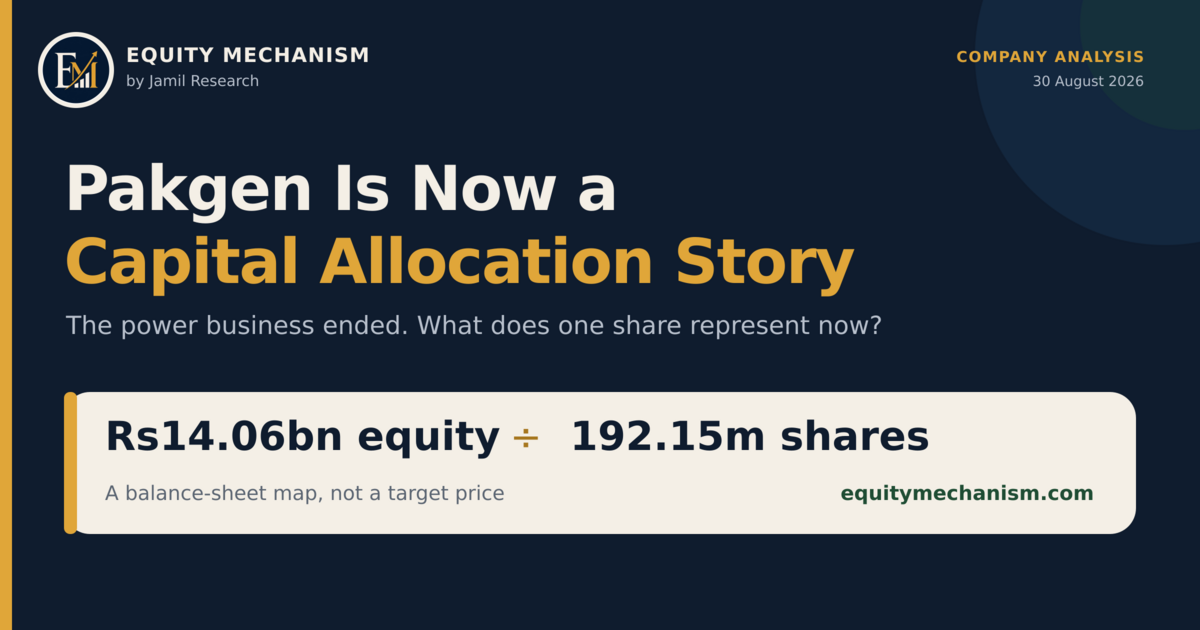
Pakgen reported equity of Rs14,056,812,000 and 192,148,603 outstanding shares.
Rs14,056,812,000 divided by 192,148,603 = Rs73.1559, or approximately Rs73.16 of reported equity per share.
This is a calculation from the filing, not a valuation conclusion. Several reasons prevent it from becoming a target price:
- Some assets are measured at fair value while investment property is carried at cost.
- Legacy assets may sell above or below their carrying amounts and may require disposal costs.
- Taxes, contingencies and preservation costs can affect what shareholders ultimately receive.
- A controlled investment company can trade at a discount or premium depending on governance, liquidity and capital allocation.
- Future investments can change both risk and asset mix.
The number is useful because it forces the analysis to begin with the balance sheet. It is not useful as a shortcut to a buy or sell decision.
The earnings bridge now has two businesses
For H1 2026, Pakgen reported:
| Earnings item | H1 2026 | Interpretation |
|---|---|---|
| Gain on sale of investments | Rs397.4m | Largest component of reported continuing revenue |
| Return on investments | Rs0.4m | Small recurring cash return in the period |
| Unrealised short-term investment gain | Rs25.7m | Non-cash fair-value movement |
| Initial FVTOCI recognition loss | Rs180.6m | Accounting effect on the Rafhan acquisition |
| Operating and administrative expenses | Rs47.5m | Cost of running the continuing company |
| Profit from continuing operations | Rs203.2m | Before finance cost and discontinued operations |
| Loss from discontinued operations | Rs223.6m | Legacy power operation and related disposal or preservation effects |
| Loss after tax | Rs88.2m | Equal to a Rs0.46 loss per share |
The continuing business was profitable at the operating line, but the overall half year still ended in a loss. More importantly, most continuing revenue came from gains on selling investments rather than a large stream of interest or dividends.
Named inference: the first full test of the new model is not whether Pakgen can record gains in one period. It is whether the portfolio can produce repeatable, risk-adjusted income while management protects capital and explains the role of each major holding.
Why Rs7.23bn of operating cash flow needs context
The cash-flow statement reports Rs7.225 billion of net cash generated from operating activities. Read alone, that looks stronger than the reported loss.
The reconciliation explains the gap. A Rs6.886 billion reduction in short-term investments was included inside working-capital changes. In an investment-focused company, purchases and disposals of short-term investments can sit closer to the operating cycle than they would in a manufacturing company.
That means the Rs7.225 billion figure should not be read as cash generated by a continuing power or industrial operating engine. It mainly shows capital moving out of short-term investments, while Rs6.064 billion went into the long-term Rafhan holding and another Rs1.180 billion was paid for the remaining buyback activity during the half year.
The cash-flow statement is internally consistent. The interpretation simply has to change with the business model.
Legacy assets still matter
Pakgen classified Rs1.415 billion of non-current assets as held for sale. These mainly represent plant, machinery and a sizeable part of buildings. The filing also showed Rs426.6 million of stores, spares and consumables, which were in the disposal process but remained current assets.
Only a small portion had been sold by period end. Note 9 recorded assets with a Rs3.198 million net book value sold for Rs3.678 million. The directors' broader disposal update also included other approved asset categories and showed that the process was still at an early stage.
The retained land and buildings classified as investment property had a carrying amount of Rs262.878 million. The filing disclosed a higher independent fair value based on the 31 December 2025 valuation. That difference may matter, but it is not cash until an asset is sold, rented or otherwise monetised.
FESCO is an option, not a current asset
After the reporting date, Pakgen joined a consortium for the proposed privatisation of Faisalabad Electric Supply Company and became the lead consortium member. The filing is equally clear that Pakgen had not assumed a binding obligation at the report date. Participation remained subject to pre-qualification and required approvals.
FESCO should therefore sit on the watch list, not inside the current ownership map or a completed-investment valuation. If the process becomes binding, investors will need the proposed funding structure, Pakgen's economic share, governance rights and expected capital commitment before assessing the effect.
Verified fact: Pakgen's current balance sheet is dominated by investments and cash, the Rafhan holding, assets held for sale and investment property. The share count is 48.36% lower, calculated, and NML controls 58.57%.
Named inference: Pakgen should now be assessed primarily as a capital allocator. The quality of future results will depend more on portfolio returns, asset-sale execution, governance and reinvestment decisions than on the old plant's dispatch.
Alternative interpretation
A more optimistic reading is that Pakgen has already converted a stranded operating model into a liquid, low-liability investment vehicle with a strategic holding and valuable land. On that reading, the small liability base, reduced share count and possible difference between property carrying values and disclosed valuations offer a cleaner platform for future value creation.
That reading is possible, but it still needs evidence. The portfolio must generate repeatable returns, legacy assets must be sold sensibly, and new commitments must be explained clearly. A strong balance sheet can create optionality, but it does not remove capital-allocation risk.
Risks, limits and falsifiers
- Interim-report limit: The financial statements are un-audited, although the half-year figures received a limited-scope review.
- Valuation limit: Rs73.16 is accounting equity per share, not recoverable value or a target price.
- Concentration risk: The Rafhan stake is a large part of Pakgen's asset base.
- Execution risk: Legacy assets may take longer to sell or realise different values from their carrying amounts.
- Governance risk: NML controls Pakgen after the buyback, so minority holders should monitor related-party transactions and allocation decisions.
- Legacy risk: Tax disputes, preservation costs and other obligations from the power business can continue after generation stops.
- Falsifier: If recurring portfolio income remains weak while new capital commitments grow, the capital-allocation thesis would weaken.
What to watch in the next filing
- Dividends and fair-value movement from the Rafhan stake.
- Recurring income separated from gains on selling investments.
- Sale proceeds, carrying values and costs for legacy plant, buildings, stores and spares.
- Any change in investment property use or monetisation.
- New investments, distributions or further changes in the portfolio.
- Any binding FESCO step and Pakgen's required funding share.
- Related-party exposures and the board's explanation of capital-allocation discipline.
Method and calculations
All reported figures come from Pakgen Limited's half-year report for the period ended 30 June 2026. Rupee figures were converted from thousands to millions or billions and rounded for readability.
Share-count reduction equals 179,932,988 cancelled shares divided by 372,081,591 shares before cancellation. Reported equity per share equals Rs14,056,812,000 divided by 192,148,603 outstanding shares. Asset percentages use Rs14,281,977,000 of total assets as the denominator.
The analysis does not use the current market price to create a target, expected return or recommendation.