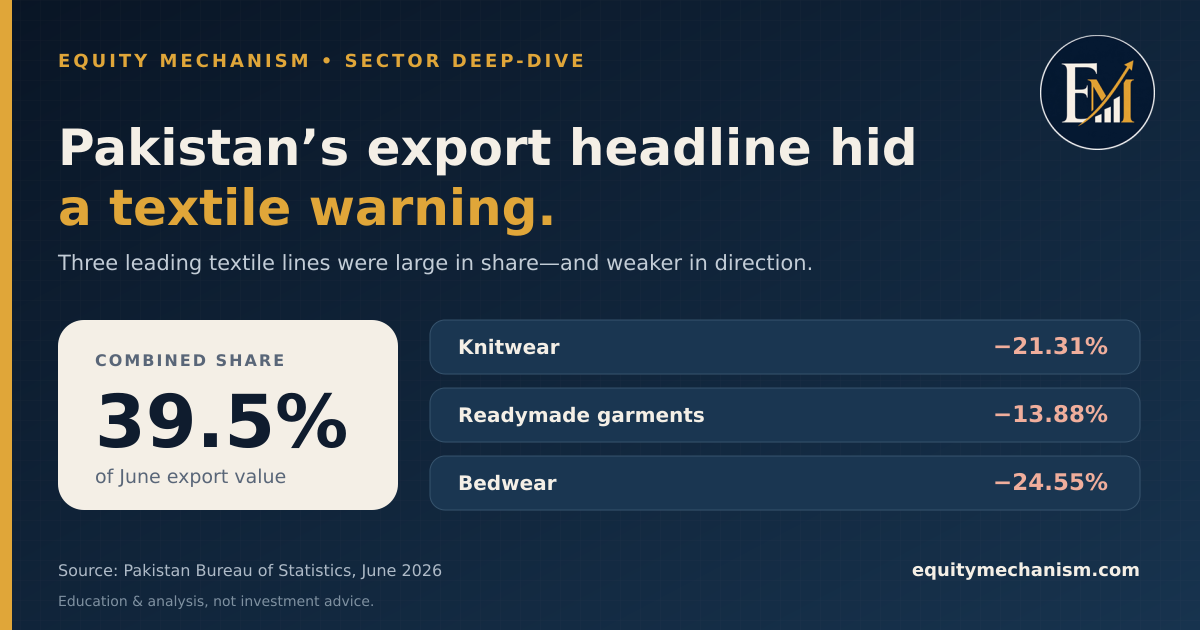
Pakistan’s June export decline was not only about the national total. The composition of that total shows why textiles remain central to the external account, and why one month of weakness deserves attention without being treated as a complete trend.
- Pakistan exported goods worth $2.252 billion in June 2026, down 9.08% from June 2025 and 16.25% from May.
- Knitwear, readymade garments and bedwear generated a combined Rs247.477 billion, equal to 39.49% of June’s total export value.
- Their year-on-year rupee values fell 21.31%, 13.88% and 24.55%, respectively.
- The figures establish national commodity-level weakness. They do not establish the results of every listed textile company.
Export value → orders, quantities and prices → factory utilisation → foreign-currency receipts → revenue, margins and employment → company-filing confirmation
What happened
Pakistan’s goods exports were Rs626.686 billion, or $2.252 billion, in June 2026, according to the Pakistan Bureau of Statistics.
In US-dollar terms, the monthly total was 16.25% below May and 9.08% below June 2025. Across the full 2025–26 fiscal year, exports were $30.139 billion, down 5.93% from the previous year.
Those headline figures describe the direction of total exports. The product breakdown shows where a material part of the June weakness appeared.
| Textile category | June 2026 export value | Change from June 2025 |
|---|---|---|
| Knitwear | Rs101.348bn | −21.31% |
| Readymade garments | Rs87.768bn | −13.88% |
| Bedwear | Rs58.361bn | −24.55% |
| Combined | Rs247.477bn | — |
Together, these three categories represented 39.49% of the country’s June export value. In plain language, nearly four of every ten export rupees came from three textile lines that were each below their year-earlier value.
The mechanism
The first step is to separate export value from export quantity.
A lower export value can result from fewer units being shipped, lower selling prices, a different product mix, currency translation or some combination of these factors. The headline release confirms the value change, but a complete diagnosis requires the detailed quantity data and company disclosures.
If lower value reflects weaker orders or quantities, factories may operate below their earlier utilisation levels. That can change the absorption of fixed costs and affect operating efficiency.
The next transmission is through foreign currency. Export proceeds provide dollars and other currencies to the economy. When a major export group produces less value, the flow of foreign-currency receipts can weaken unless other exports or external inflows compensate.
At company level, the direction is less automatic. A listed exporter may have a different mix of products, customers and destinations from the national category. Currency movements can support rupee revenue, while cotton, energy, labour and financing costs can move margins in the opposite direction. This is why the national release is a sector signal, not a substitute for company accounts.
Verified fact: PBS reported lower year-on-year rupee export values for knitwear, readymade garments and bedwear in June 2026.
Named inference: If weaker value reflects lower orders or quantities, production utilisation and foreign-currency receipts may come under pressure. Individual company effects require filing-level confirmation.
What supports the warning
The first supporting point is the size of the categories. A combined 39.49% share makes their movement material to the national export picture.
The second is that weakness appeared across all three categories rather than in only one textile line. The declines ranged from 13.88% to 24.55% in rupee value compared with June 2025.
The third is the broader export backdrop. Full-year goods exports were also below the previous fiscal year in US-dollar terms. That does not prove the same cause, but it means the June textile figures did not occur beside a rising annual export total.
What weakens the warning
June is one month. Monthly trade data can be affected by shipment timing, holidays, order schedules and changes in product mix.
The decline was also not universal across exports. PBS reported year-on-year increases in other rice and basmati-rice export values, showing that different product groups were moving in different directions.
Most importantly, national commodity data cannot be mapped directly onto every listed textile company. Some businesses have higher-value products, different destinations, more efficient plants or better cost control. The warning becomes company evidence only when financial statements, export quantities and management commentary confirm it.
The main risk is treating a single weak month as a settled trend. A broad recovery in July textile quantities and values would weaken the warning. A second risk is assuming that every listed exporter follows the national category average.
What the next export and filing data should show
- July export value and quantity: quantity can help separate shipment weakness from price or mix effects.
- Cotton, energy and labour costs: revenue direction alone does not determine margins.
- Currency movement: exchange rates affect both translated export revenue and imported inputs.
- Company results: sales, gross margins, capacity utilisation and management commentary provide the filing-level test.
- Destination demand: changes in orders from major markets can confirm whether the weakness is temporary or broader.
The mechanism is therefore not “textiles fell, so every textile company weakened.” It is more disciplined: three large export categories lost value, that can affect production and foreign-currency receipts, and company filings must show where the effect actually landed.