- Sector
- cement
KSE-100 closed at 185,372.21 on Friday, July 3, up 3.23% for the week.
The cement sector entered FY27 with two facts that look supportive on the surface.
First, FY26 dispatch data was strong. Second, the federal government has entered FY27 with a large Public Sector Development Programme.
The easy conclusion is that cement demand should immediately benefit from government development spending. That conclusion is too fast.
The better question is simpler: how does a budget allocation become cement demand?
That mechanism is not instant.
It moves through fund authorisation, government departments responsible for projects, project work, contractor mobilisation, and only then site-level cement orders. The difference between an announced development budget and cement dispatches is the difference between a number on paper and concrete poured on site.
The demand data is strong
APCMA’s FY26 dispatch data does not support a weak-demand story.
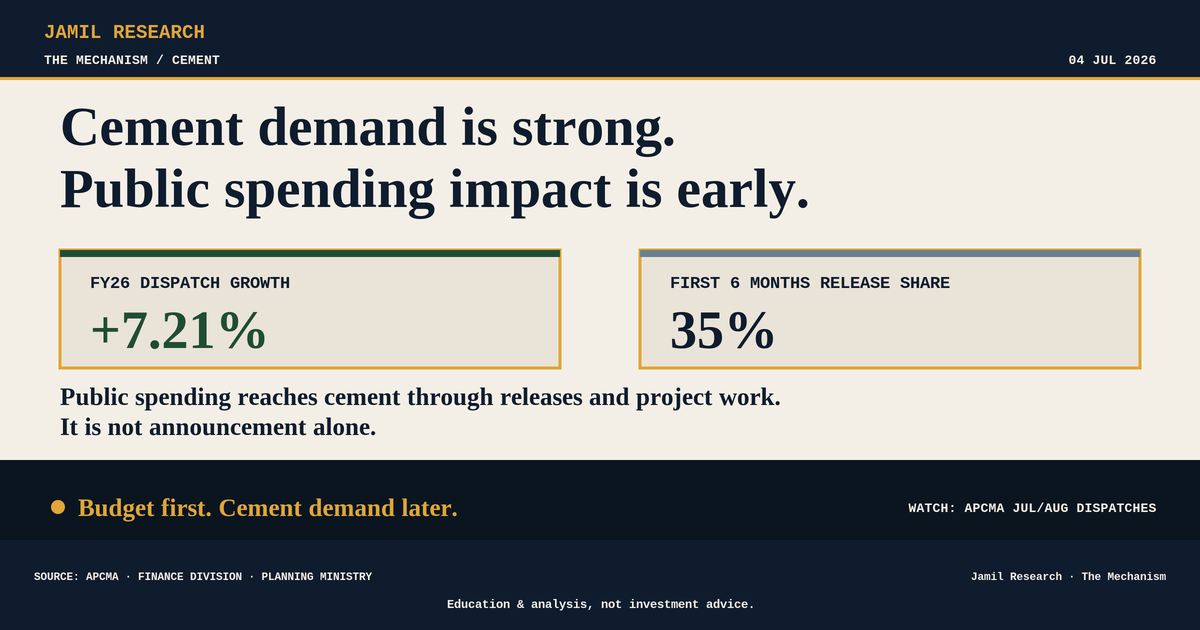
Total cement dispatches reached 50.515 million tons in FY26, up 7.21% from 47.116 million tons in FY25. Local sales rose from 37.906 million tons to 41.507 million tons, a 9.5% increase.
Exports moved the other way, falling 2.19% to 9.008 million tons.
June 2026 was also strong. Total dispatches reached 4.331 million tons, up 18.38% from June 2025. Local dispatches were 3.541 million tons, up 26.78%.
So the core issue is not whether cement demand exists. It does.
The issue is what is driving it, and when the Public Sector Development Programme begins adding a separate demand impulse.
What the Public Sector Development Programme can and cannot do
The Public Sector Development Programme matters for cement because government development spending eventually turns into roads, bridges, water projects, public buildings, and other construction work.
But the timing matters.
A budget allocation does not automatically become construction activity. The chain is:
Budget allocation → funds authorised → project departments → project work → contractor mobilisation → cement orders
Each step takes time. Each step can also be delayed.
The official FY27 release strategy makes the timing visible. Development funds are authorised at 15% in Q1, 20% in Q2, 25% in Q3, and 40% in Q4.
Put more simply: 35% is scheduled for the first 6 months, while 65% is scheduled for the last 6 months.
The same release strategy also states that releases are subject to fiscal space.
That line matters. It means even an approved schedule is not the same as guaranteed spending. Fiscal pressure can still slow or reduce releases.
FY26 is the warning
FY26 shows why the headline allocation should not be treated as the full story.
The Public Sector Development Programme was originally set at Rs1.01 trillion. By May 2026, actual utilisation was Rs529.8 billion, or 52.4% of the original allocation.
The development programme was later cut by Rs173 billion. Yet cement dispatches still rose 7.21% in FY26.
This creates an important distinction.
FY26 cement growth was real. But it was not a clean proof that federal development spending was the main driver. The safer reading is that cement demand had support beyond federal development spending. Private construction and lower financing costs likely helped the demand base, but that should be treated as an inference, not a verified fact.
For FY27, this matters because investors and analysts can be right about the direction of the Public Sector Development Programme story, but early on timing.
The first 6 months of FY27 may still reflect private demand, seasonality, and the pace of actual releases more than the full-year Public Sector Development Programme number.
The market signal is positioning, not proof
NCCPL flow data for the week of June 30 to July 3 showed mutual funds as net buyers of cement sector stocks at +$3.88 million in the regular market, while foreign institutional investors were net sellers at -$1.39 million.
This is useful, but it should not dominate the story.
The flow data shows positioning. It does not prove the mechanism.
The mechanism is still the same: government development spending helps cement only when money moves from budget allocation to project execution and then into site-level material demand.
That is why APCMA dispatch data is more important than the flow table.
What would confirm the thesis
The next useful evidence is APCMA dispatch data for July and August 2026. Those months matter because they sit inside the first quarter of FY27, when the official release schedule authorises only 15% of development funds.
If local dispatches hold above last year’s comparable months despite normal seasonal pressure, it would suggest the demand base is strong even before the Public Sector Development Programme impact becomes visible.
If local dispatches fall back sharply, the interpretation changes. It would mean FY27 cement demand is still waiting for later-stage government execution to support the sector.
The second watch item is fiscal space.
The FY27 release strategy explicitly says releases depend on fiscal space. That makes FBR tax collection important. If revenue collection falls behind the budget path, the risk of slower development releases rises.
The mechanism
The Public Sector Development Programme is positive for cement, but it is not immediate cement demand.
That is the key distinction.
Cement demand is already strong. FY26 dispatches confirm that.
The Public Sector Development Programme impact is still early. The official release schedule confirms that.
The market should not ask only whether the Public Sector Development Programme number is large. It should ask whether funds are released, projects move, and APCMA dispatches confirm that construction activity is reaching cement producers.
That is the mechanism.
Sources & notes
- APCMA
- Finance Division
- Ministry of Planning and Development
- Pakistan Economic Survey 2025-26
- NCCPL
- PSX