- Sector
- cross-sector
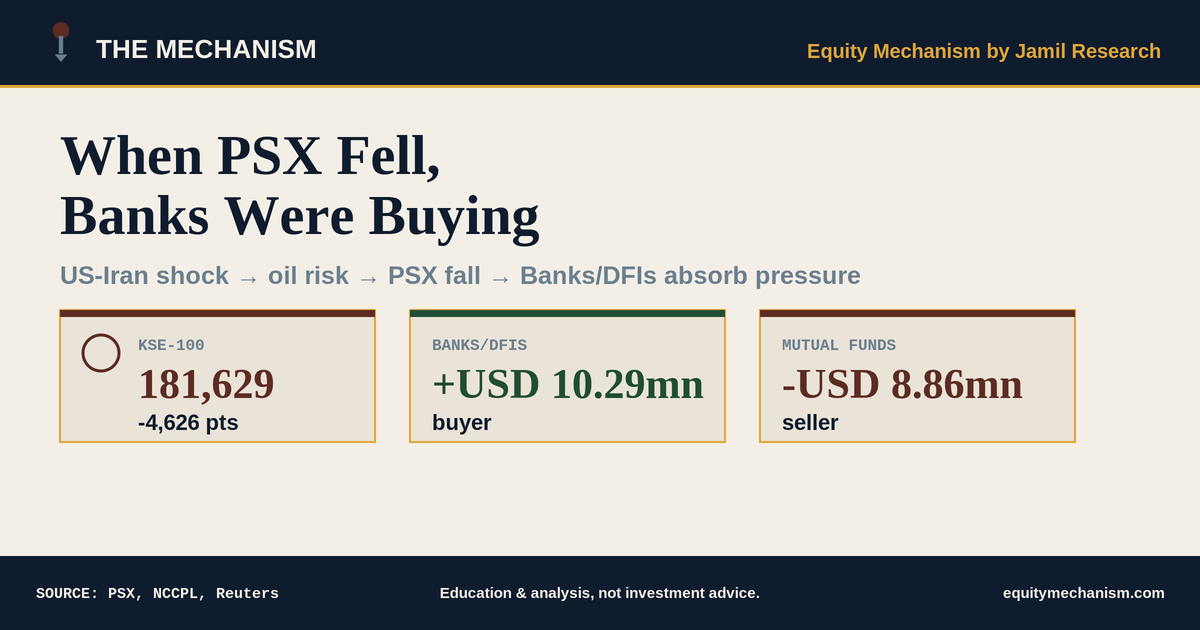
The KSE-100 fell 4,626 points on July 8 and closed at 181,629.
Total PSX volume was 1.55bn shares. Market breadth was weak: 396 stocks declined, 87 advanced, and 81 were unchanged.
But this was not just a red day.
It was an event test.
The external trigger
The trigger was renewed US-Iran tension and higher oil prices.
For Pakistan, oil is not just a global headline. It affects the import bill, inflation expectations, the rupee, and interest-rate expectations.
That chain can quickly move from global news to PSX sentiment.
Why flows matter
When an external risk hits the market, the index tells only part of the story.
The more useful question is:
Who sold, and who absorbed the selling?
NCCPL figures checked for this note show mutual funds sold USD 8.86mn on July 8.
That selling matters because mutual funds were a visible seller when the market was already reacting to external risk. When selling pressure appears during a sharp fall, the day becomes more than an index move. It becomes a positioning test.
The buyer that stood out
The buyer on the other side was Banks and Development Financial Institutions (DFIs).
Banks/DFIs bought USD 10.29mn while the market was under pressure.
This does not mean the fall is over. It means one institutional group absorbed part of the selling after the oil and regional-risk shock.
That is the mechanism worth tracking.
Retail flows need careful reading
Individuals were also net sellers of USD 1.58mn on July 8. So the absorption did not come from retail.
The main local buyer group in the checked NCCPL equity file was Banks/DFIs, while mutual funds and individuals were both sellers.
What would confirm the signal?
The key check is NCCPL bank/DFI flows for July 9 and July 10.
If bank/DFI buying continues, the absorption signal becomes stronger.
If it fades or turns negative, July 8 may have been a one-day flow event.
One session is not a trend.
The mechanism
US-Iran shock → oil risk → PSX falls → funds sell → retail cools → banks/DFIs absorb selling
That is the useful read from the day.
The market did not only fall. It showed where selling pressure came from and which investor category absorbed part of it.
Sources & notes
- PSXMarket data.
- NCCPLParticipant-flow data.
- ReutersExternal-risk context.