- Sector
- cross-sector
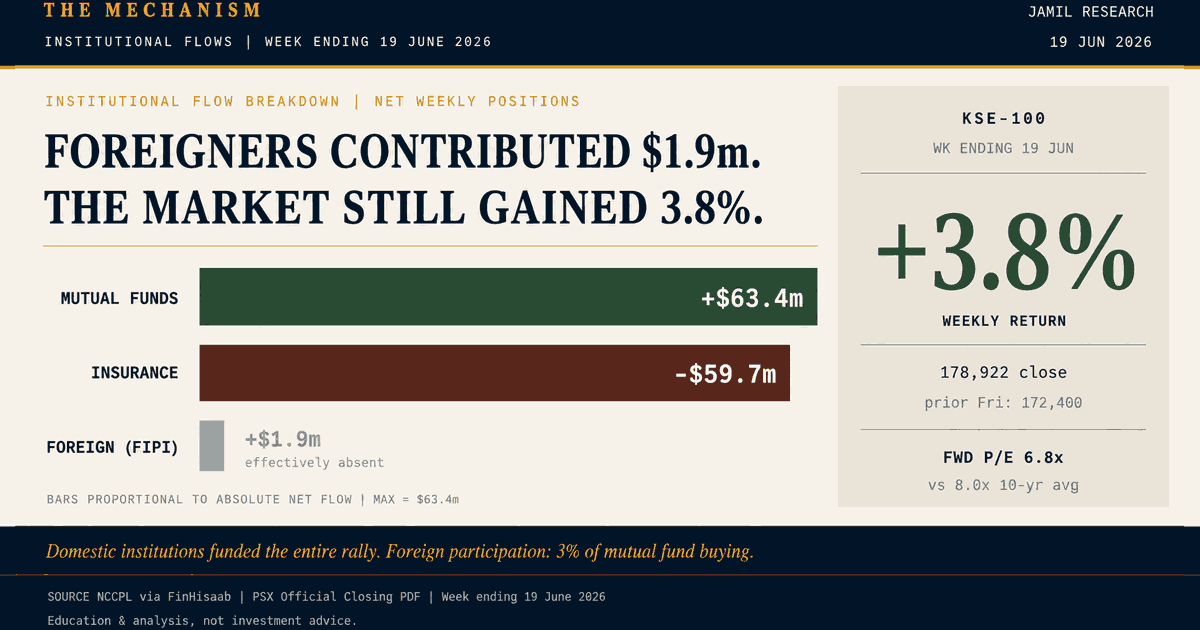
The mechanism in brief. KSE-100 closed the week ending 19 June 2026 at 178,922.76, up 3.8%. Foreign institutional investors added only $1.9m. The rally was funded almost entirely by domestic institutions, especially mutual funds.
The Setup
Pakistan equities entered the week with a valuation discount and improving macro expectations.
KSE-100 was trading near 6.8x forward earnings versus a 10-year average near 8.0x. The index was also below its January 2026 intraday high of 191,032.73. On valuation alone, the market had room to re-rate.
But valuation is not enough. A discount closes only when capital arrives with a reason to pay a higher multiple.
This week, the capital came from domestic institutions.
The Flow Data
Weekly NCCPL flow data for 13-19 June showed three important numbers:
| Investor cohort | Net flow |
|---|---|
| Mutual funds | +$63.4m |
| Insurance companies | -$59.7m |
| Foreign institutional investors | +$1.9m |
The foreign number needs simple framing. In the context of a full market week, $1.9m is not leadership. It is effective absence.
The 3.8% index gain was therefore not a foreign-capital story. It was a domestic mutual-fund story.
Where the Mutual Fund Money Went
The sector allocation gives the thesis.
Mutual funds allocated $21.6m to banks, $11.6m to cement, $9.1m to E&P, $5.1m to power, $3.4m to technology, $1.9m to food, and $1.5m to fertiliser.
This was not random buying. Banks and cement are rate-sensitive. If inflation softens and the SBP eventually cuts, both sectors have a direct transmission channel.
Banks can benefit from better loan demand and a changing spread environment. Cement can benefit from lower financing costs and improved construction activity. E&P has a different route: lower oil can ease fiscal pressure, which can improve the probability of receivables and circular-debt recovery.
The mutual fund allocation therefore reads as a forward-positioning bet on FY27 easing and fiscal relief.
What Insurance Selling Means
Insurance companies sold $59.7m in the same week. That should not be read as a simple bearish call.
Insurers are liability-driven investors. Their portfolios must match long-term policy liabilities, and high T-bill yields can make fixed income attractive on a risk-adjusted basis. Selling equities into a rising market can also be ordinary rebalancing after equity weights increase.
The correct interpretation is not “insurance is bearish.” It is “insurance has a different mandate.”
That difference matters because mutual funds are return-seeking equity allocators, while insurers manage liabilities and duration. They can be on opposite sides of the same market without one side being irrational.
The Sustainability Question
A rally funded by domestic mutual funds can continue, but it has limits.
Mutual funds need inflows, mandate room, or rotation capacity to keep buying. If those flows slow, the same market may need a second source of demand.
For a full re-rating toward historical multiples, foreign capital would make the move more durable. Foreign institutions have been cautious since the January high. A meaningful return would signal that the risk-premium thesis is now accepted beyond the domestic investor base.
What would confirm or break the re-rating
The key falsifier is foreign flow.
If FIPI turns into sustained buying above $10m per week for several weeks, the market's re-rating has a stronger capital base. If foreigners remain absent while domestic mutual funds slow, the market can hold levels but may struggle to close the valuation gap quickly.
The second watch item is whether mutual fund buying remains concentrated in banks, cement, and E&P. If the same allocation persists, the easing-cycle thesis is still active. If it reverses, the prior week may have been tactical rather than structural.
Primary sources: PSX official closing PDF, week ending 19 June 2026; NCCPL institutional flow data via FinHisaab; KSE-100 ATH reference, January 2026 intraday high.
Sources & notes
- PSX
- NCCPL
- FinHisaab