- Sector
- energy
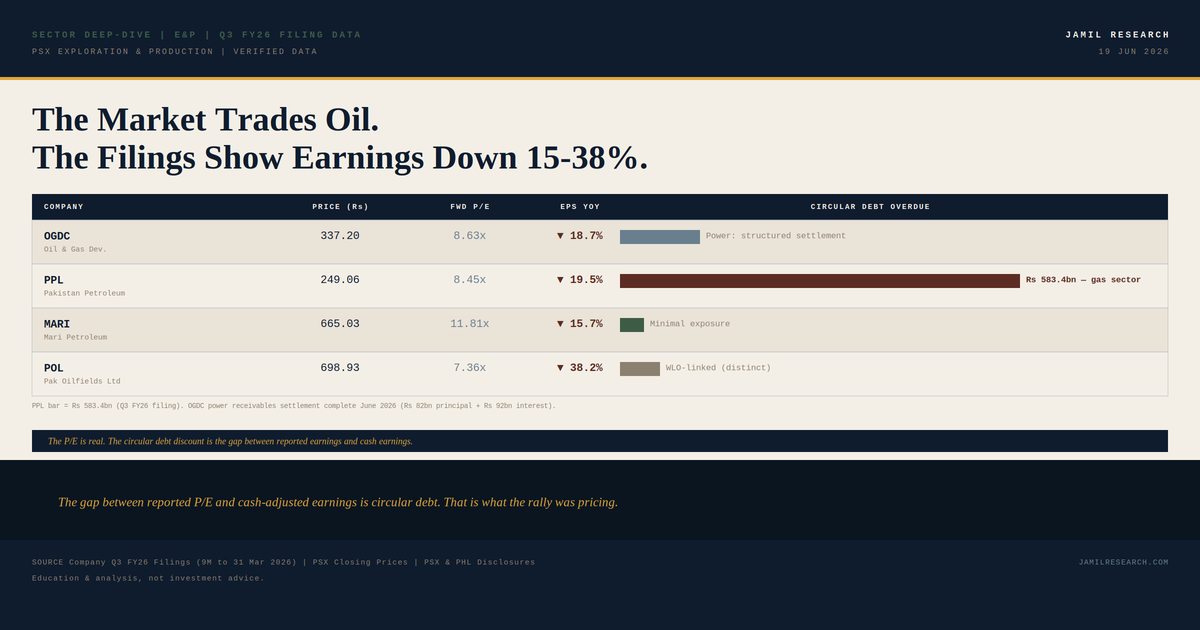
The mechanism in brief. The four listed E&P names reported EPS declines of 15-38% in the nine months to March 2026. The sector still participated in the de-escalation rally. That is not a contradiction if the market was pricing circular-debt recovery rather than current earnings momentum.
The Filing Baseline
The Q3 FY26 filings are clear: this was not an earnings-upgrade story.
| Company | Price, 18 Jun 2026 | Forward P/E | 9M FY26 EPS YoY | Key receivables point |
|---|---|---|---|---|
| OGDC | Rs 337.20 | 8.63x | -18.7% | Power receivables substantially settled; gas receivables remain relevant |
| PPL | Rs 249.06 | 8.45x | -19.5% | Gas-sector overdue receivables of Rs 583.4bn |
| MARI | Rs 665.03 | 11.81x | -15.7% | Minimal circular-debt exposure |
| POL | Rs 698.93 | 7.36x | -38.2% | WLO-linked receivables, structurally different |
Every company in the group showed lower earnings year-on-year. That makes the sector rally analytically useful. It forces the question: what exactly was the market buying?
The Circular-Debt Discount
Circular debt creates a wedge between reported earnings and cash earnings.
E&P companies can recognise revenue when energy is supplied, even if the related cash is not received on time. The profit exists in the accounts, but the market discounts it if collection is uncertain or delayed.
That is why a reported P/E can mislead. A company trading at 8.5x reported earnings is not the same as a company trading at 8.5x cash earnings if a large portion of revenue remains stuck in receivables.
For PPL, the Q3 FY26 figure of Rs 583.4bn in overdue gas-sector receivables is the key balance-sheet issue. The market is not only pricing the current year's EPS. It is pricing whether that receivable balance is recoverable, delayed, or impaired in real terms.
OGDC Is Different From PPL
OGDC needs separate treatment.
Its power-sector receivables had a structured settlement route: Rs 82bn principal and Rs 92bn interest under the PHL plan. By late June 2026, that settlement process was materially complete.
That does not remove all receivables risk. Gas-sector receivables from the Sui companies still matter. But OGDC's risk is not identical to PPL's. One has a large part of the issue moving through a structured payment plan. The other has a larger unresolved gas-sector receivables burden.
Treating both companies as one identical circular-debt basket misses the mechanism.
Why MARI Trades at a Premium
MARI's premium multiple is not only about growth. It is also about cash quality.
With minimal circular-debt exposure relative to its market value, MARI's reported earnings are closer to cash earnings. That reduces the receivables discount investors need to apply. A higher multiple is therefore structurally easier to justify than it would be for a company with the same EPS but a weaker collection profile.
The question is not whether MARI deserves any premium. It is whether the size of the premium is still reasonable.
POL's Separate Cash Question
POL has a different receivables structure, linked to WLO arrangements rather than the same gas and power circular-debt chain facing OGDC and PPL.
Its EPS decline was the largest in the group at 38.2%. That makes dividend sustainability and cash conversion important watch items. A high payout can be supported by accumulated reserves or balance-sheet strength for a period, but it should still be tested against recurring earnings and cash generation.
What the Rally Was Pricing
The E&P rally during the de-escalation week was not a simple oil-price rally. Lower oil is not automatically good for producers.
The market was likely pricing the fiscal chain:
Lower oil → lower import bill → more fiscal space → higher probability of circular-debt settlement → receivables discount narrows → E&P valuations re-rate.
That chain is plausible, but it is not guaranteed. Lower oil does not automatically make the government pay receivables. It only improves the capacity to do so.
FY26 filings and the FY27 budget
The main falsifier is the next set of full-year FY26 filings. If PPL's overdue receivables remain flat or rise from Rs 583.4bn, the resolution trade weakens. If the number starts falling meaningfully, the market's inference gains support.
The second watch item is the FY27 budget and energy-sector cash allocation. Circular-debt settlement needs fiscal capacity and political priority. Budget documents reveal whether the commitment has actual funding behind it.
Primary sources: Company quarterly filings Q3 FY26; PSX official closing prices; PSX company disclosures; Business Recorder; Mettis Global.
Sources & notes
- PSX
- Company quarterly filings Q3 FY26
- PSX company disclosures
- Business Recorder
- Mettis Global