- Sector
- macro
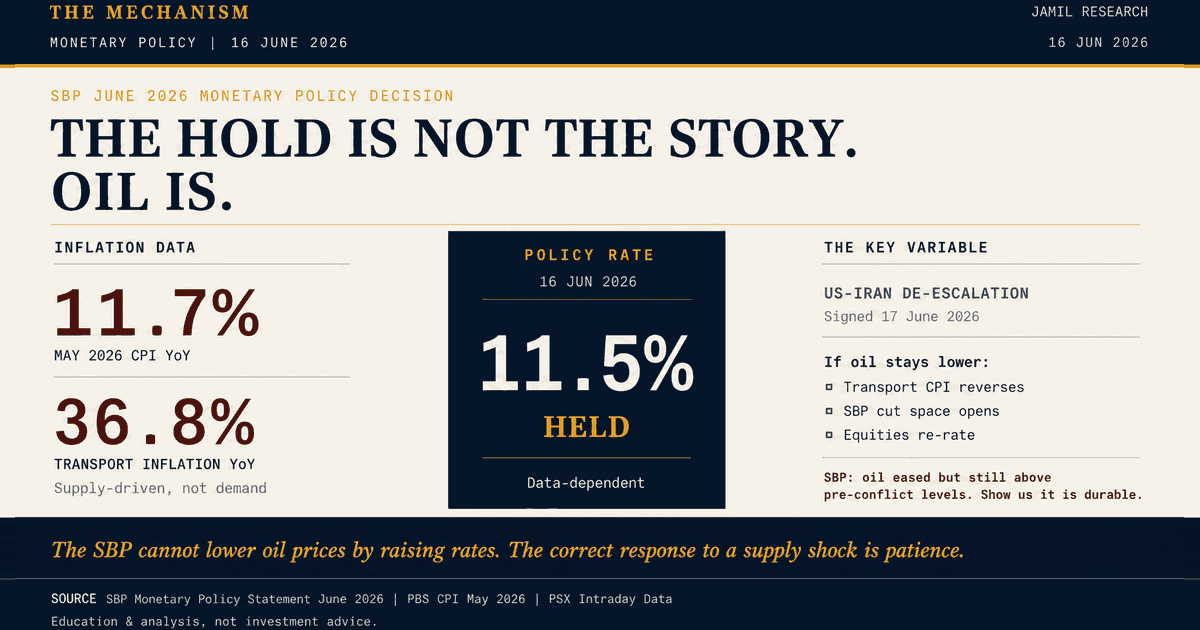
The mechanism in brief. The SBP held the policy rate at 11.5% on 16 June 2026. That was the expected decision. The more useful read is why it held: inflation pressure was still visible, but the oil-price channel had started to change. The SBP needed evidence that the change was durable before acting on it.
The Rate Was Not the Story
A rate hold at 11.5% was not a surprise by itself. May CPI was 11.7% year-on-year, up from 10.9% in April. On headline inflation alone, caution was the natural central-bank response.
The important detail is the composition of inflation.
Pakistan's May inflation was not mainly a demand-overheating story. The more visible pressure came from supply-side and imported-cost channels, especially transport inflation at 36.8% year-on-year. Transport inflation in Pakistan links closely to fuel prices, and fuel prices link to the landed cost of imported crude.
A central bank can cool demand by raising rates. It cannot lower crude oil prices by raising rates.
That difference matters. If inflation comes from excess demand, tighter policy works directly. If inflation comes from imported fuel costs, the central bank can only prevent second-round effects and wait for the supply shock to pass.
What Changed Around the Decision
On the same day, the market was reacting to US-Iran de-escalation. Oil eased as the Middle East risk premium came down.
For Pakistan, the chain was clear:
Lower geopolitical risk → lower oil-risk premium → lower import pressure → softer fuel costs → lower transport CPI → more room for SBP cuts → lower equity discount rates.
The equity market moved quickly because it prices forward conditions. The SBP moved slowly because it requires evidence.
That is not a contradiction. It is a difference in mandate.
Why the SBP Waited
The SBP's caution was logical. A one-day oil move can reverse. A geopolitical headline can fade. The bank had to decide policy using confirmed inflation data, not only market expectations.
The correct interpretation is not that the SBP rejected the easing thesis. It is that the bank had not yet received enough proof to act on it.
For equities, this creates a timing gap. The market can re-rate on the probability of future cuts before the SBP actually cuts. The risk is that the data does not confirm the probability.
Bond Market Versus Equity Market
This is why fixed income and equities can appear to disagree.
Short-term T-bill investors price the next few policy meetings. They care about the central bank's actual next move. With headline CPI still elevated, they can justify higher yields or a longer hold.
Equity investors price a longer earnings stream. They care more about where rates are likely to be over the full cycle. If oil stays lower and CPI follows, equities may move before the cut is delivered.
Both markets can be rational at the same time. They are pricing different horizons.
The Assumption Behind the Equity Move
The equity thesis depends on two assumptions.
First, US-Iran de-escalation must keep the oil-risk premium lower for more than a few days. Second, lower crude must pass through to domestic fuel costs and then into the transport component of CPI.
If those assumptions hold, the rate-cut path becomes more credible. If oil rebounds or domestic prices do not adjust, the re-rating weakens.
This is why oil, not the 11.5% policy-rate headline, was the key variable.
Three checks on the pass-through
The first watch item is OGRA fuel-price notifications. They show whether lower crude is reaching domestic pump prices.
The second is the next CPI print from the Pakistan Bureau of Statistics, especially the transport line. A clear deceleration in transport CPI would support the market's easing thesis.
The third is T-bill auction yields. If short-tenor yields start falling before the next policy meeting, the fixed-income market is also beginning to price the cut.
Until then, the SBP hold should be read as patience under uncertainty, not as a rejection of the easing cycle.
Primary sources: SBP monetary policy statement, June 2026; PBS CPI release, May 2026; PSX intraday data, 16 June 2026.
Sources & notes
- SBP
- PBS
- PSX