- Sector
- market-structure
Most people read the Pakistan stock market from the index level first.
The KSE-100 is up.
The KSE-100 is down.
A few large stocks are green.
A few sectors are red.
That is the headline. But the headline is not the mechanism.
A better way to read the market is to ask six simple questions:
- What moved?
- Which sectors drove the move?
- Who was buying or selling?
- Are earnings improving?
- Is valuation changing?
- What would prove the market reading wrong?
This guide explains the basic map.
1. Start with the index, but do not stop there
The KSE-100 is the most commonly quoted index in Pakistan’s stock market. It gives a quick view of market direction.
But one index number can hide many things.
The index can rise because a few large companies moved strongly. It can fall even when many smaller stocks are stable. It can also look strong while market breadth is weak.
That is why the index is only the first layer.
The better question is:
Was the move broad, or was it driven by a small number of large stocks?
If the index rises and many sectors participate, the move has broader support. If the index rises mainly because of a few heavyweights, the move is narrower.
2. Read sectors before individual stocks
Pakistan’s market is sector-heavy.
Banks, oil and gas exploration, fertiliser, cement, power, textiles, technology, autos, pharmaceuticals, and OMCs can move for different reasons.
A banking rally may be about interest rates, deposit costs, or loan growth.
A cement rally may be about dispatches, coal cost, pricing, or public-sector development spending.
An oil and gas move may be about crude prices, gas pricing, circular debt, production, or receivables.
A fertiliser move may be about gas cost, urea pricing, farmer demand, or subsidy policy.
This matters because two stocks can move in the same direction for completely different reasons.
The useful question is not only:
Which stock moved?
The useful question is:
Which sector mechanism is changing?
3. Separate price movement from business performance
A stock price can rise before earnings improve. It can also fall even when the company is profitable.
Price movement reflects expectations. Business performance reflects actual results.
A good reader of the market keeps both separate.
For a company, look at:
- revenue
- gross margin
- operating profit
- net profit
- cash flow
- debt
- receivables
- dividends
- management commentary
In Pakistan, cash flow is especially important. A company can report accounting profit but still face cash collection issues. This is common in sectors affected by receivables, circular debt, delayed payments, or working-capital pressure.
The basic question is:
Is the profit converting into cash?
If the answer is no, the market may apply a discount.
4. Watch who is buying and selling
The market is not only about prices. It is also about participants.
Different investor groups can move the market in different ways.
Foreign investors, mutual funds, insurance companies, banks, companies, brokers, and individuals each have different behaviour.
Foreign buying can improve sentiment.
Mutual fund buying can absorb supply.
Insurance selling can reflect allocation or liquidity needs.
Retail participation can increase turnover but also volatility.
The important point is not to treat every flow as the same. A market rally supported by institutional absorption can be different from a rally driven mainly by short-term trading.
The mechanism question is:
Who absorbed the supply?
If buyers are broad and persistent, the move has stronger support. If buying is narrow or short-lived, the move needs confirmation.
5. Use valuation as the reality check
A good company is not automatically a good investment at every price. Valuation is the bridge between business quality and market price.
Common valuation tools include:
- price-to-earnings ratio
- price-to-book ratio
- dividend yield
- free cash flow yield
- enterprise value to EBITDA
- comparison with sector history
- comparison with the wider market
The goal is not to find one magic number. The goal is to ask:
What expectation is already priced in?
If earnings are improving and valuation is still reasonable versus history, the market may re-rate the stock. If valuation already assumes perfect execution, the risk becomes higher.
Valuation does not predict the next day’s move. It helps judge how much optimism or fear is already in the price.
6. Always identify the falsifier
Every market view needs a falsifier. A falsifier is the evidence that would prove the view wrong.
For example:
- A cement demand thesis weakens if dispatches fall for several months.
- A banking margin thesis weakens if deposit costs rise faster than asset yields.
- An oil and gas cash-flow thesis weakens if receivables keep building.
- A market liquidity thesis weakens if institutional flows turn negative and volumes fall.
- A valuation re-rating thesis weakens if earnings estimates are cut.
This is what separates analysis from opinion.
A strong market view should always answer:
What would change my mind?
The Jamil Research reading map
When reading Pakistan’s stock market, use this order:
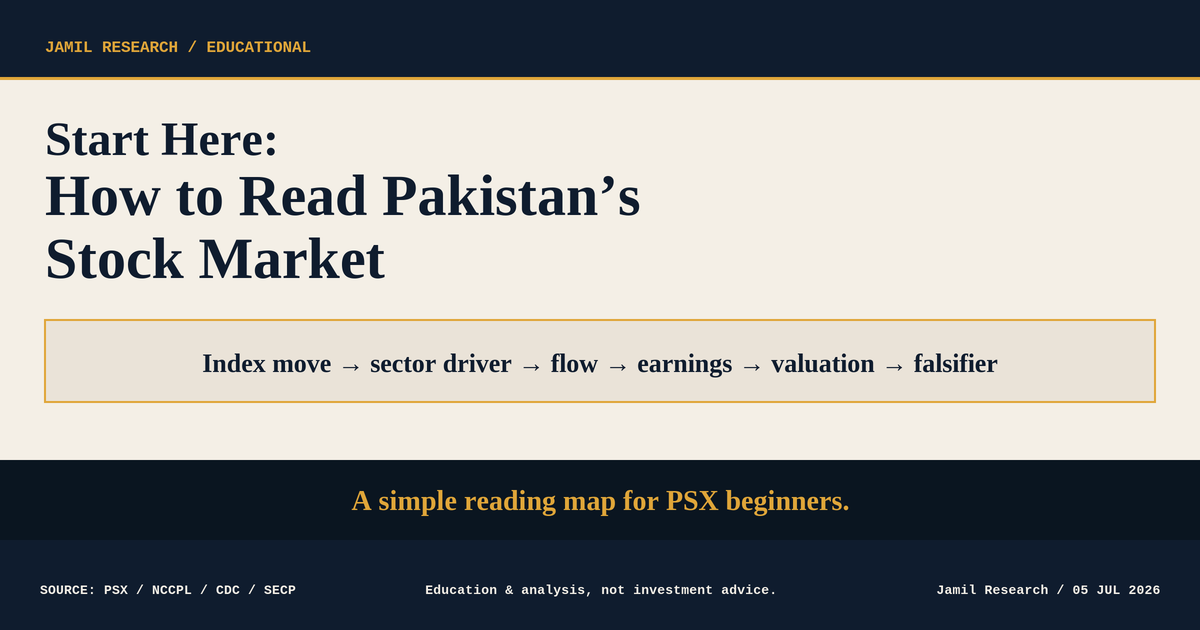
Index move → Sector driver → Participant flow → Company earnings → Valuation → Falsifier
That sequence helps avoid the most common mistake: jumping from a price move directly to a conclusion.
The market is not only a scoreboard. It is a transmission system.
Policy affects rates.
Rates affect banks and valuations.
Oil affects energy, transport, inflation, and fiscal pressure.
Budget decisions affect sectors differently.
Institutional flows affect market absorption.
Company results confirm or reject the story.
That is the mechanism.
Final takeaway
Do not start with a prediction. Start with the structure.
Ask what moved, why it moved, who participated, whether earnings support it, what valuation implies, and what evidence would break the view.
That is how to read Pakistan’s stock market without getting lost.
Sources & notes
- PSX
- NCCPL
- CDC
- SECP